Random Walk Contaminant Spread
This study examines the spread of the contaminant Methyl Parathion through a random walk simulation, focusing on its effects on Delphia Magna, a small freshwater crustacean. Utilizing EPA methodologies, the simulation models the contaminant's movement within a defined system and measures acute toxicity based on median lethal doses (LC50) and effective concentrations (EC50). Key variables such as the number of organisms, the size of the system, and the amount of contaminant are manipulated, allowing for comprehensive analysis of organism mortality over specified timeframes.

Random Walk Contaminant Spread
E N D
Presentation Transcript
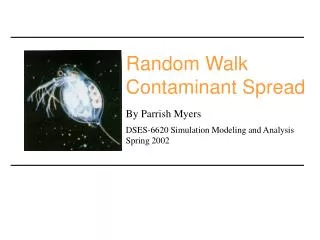
Random Walk Contaminant Spread By Parrish Myers DSES-6620 Simulation Modeling and Analysis Spring 2002
Median Lethal-Dose Acute Toxicity • Procedure Modeled after EPA SOP #2024 • Data Obtained from EPA • Organism: Delphia Magna • small freshwater crustacean • Contaminant: Methyl Parathion • insecticideLC50 = 0.14 ppb • EC50 = 0.09 – 0.2 ppb
Simulation Assumptions • 2d • Contaminant spread: random walk of constant step size and not drift • The contaminant starts at the center of the system (0,0) • The contaminant is assumed discrete, containing N groups of molecules • Exits for molecule groups: • wander beyond system boundary • collision with an organism • Stochastic susceptibility for organisms • The organisms are stationary
State Variables Modifiable • Number of Molecule Groups • Number of Organisms • Size of System System • System Time • Number of Dead Organisms • Number of Remaining Contaminant Molecule Groups • Radius of Contaminant
RWCS System Area Organism Contaminant Simulation Controls Amount of Contaminant Number of Organisms Size of System State Variables State of Simulation
Simulation Procedure • Keep system size at 50.0 and the number of organisms at 10 • Start with an amount of contaminant small enough to have minimal effect • Record the number of dead organisms at: • 1-Hour, 24-Hours, and 48-Hours • Increase the amount of contaminant and repeat step 3. • When organism mortality becomes 80%-90% STOP! • Tally data and find LD50.