Impact of Enzymes on Eucalyptus Pulp Refining for Enhanced Pulp and Paper Production
This study explores the refinement of Eucalyptus grandis and Eucalyptus nitens pulps using cellulases and hemicellulases. With the pulp and paper industry's growth, the need for sustainable wood sources has increased. Eucalyptus grandis and E. nitens are resilient choices, offering quality fibers with distinctive properties. The research details a pilot-scale refining process, revealing that enzymes significantly improve pulp characteristics. Results show notable reductions in porosity and enhancements in tensile strength, indicating the potential for tailored enzyme applications in the industry.

Impact of Enzymes on Eucalyptus Pulp Refining for Enhanced Pulp and Paper Production
E N D
Presentation Transcript
Influence of enzymes on refining of eucalyptus pulpsCrystal SteelFrancois Wolfaardt TAPPSA 2010
Aim Improve the refining of Eucalyptus grandis and E. nitens pulps using cellulases & hemicellulases
Why Eucalyptus grandis and E. nitens? • Eucalyptus grandis • Traditional wood timer source • Expansion of pulp & paper industry increased need for more land, which were at higher altitudes • E. nitens was grown due to cold tolerance • Eucalyptus nitens • Grows fast & adaptable • Good quality fibre • Smaller fibres & thinner cell walls • High tensile, bulk density, opacity and brightness Slide 4
Introduction: Refining of wood pulp fibres Refining pulp fibres Cutting Fibrillation & fines De-curling Fibre swelling Improved bonding & reduced pulp freeness Increased effective length & sheet formation Increased bonding & strength of fibres Reduced fibre length
Hemicellulose Reducing end Non-reducing end Crystalline cellulose Amorphous cellulose Introduction: Enzymes • Hemicellulase • Xylanase (X) (HW) • Cellulases • Endoglucanase (EG) • Cellobiohydrolase (CBH) X EG CBHII CBHI
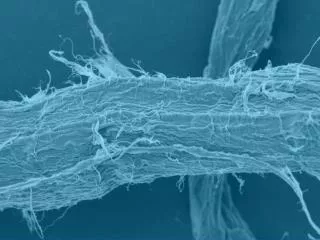
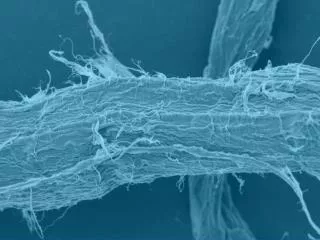
1µm Refining with enzymes Untreated Treated 1µm Hardwood pulp samples treated with endoglucanase on commercial scale with refining.
Introduction: Refining with enzymes Enzyme refining of pulp fibres Cutting ? Fibrillation & fines ? De-curling ? Fibre swelling ?
Method: Pilot scale refining • 3% pulp consistency • Enzymes: 0.02g protein/ kg pulp • Endoglucanase, Cellobiohydrolase & Xylanase • Sample before incubation, at 20 min & at each refining energy: • E. grandis 24.9, 49.2, 73.1, 96.5 & 119.4 kWh/t • E. nitens 21.5, 42.3, 62.6, 82.2 & 101.3 kWh/t Slide 9
Method: Sample analysis Pulp Freeness (CSF) Water retention value (WRV) Paper Tensile strength Tear strength Bulk density Porosity 20 cm Slide 10
Results : E. grandis & E. nitens refining curves E. nitens E. grandis
Results and Discussion Control @ 450 ml
Conclusions • Enzymes affected properties in a similar way on the two HW species • Most noted change with enzymes were: • Xylanase on E. nitens with a 75% reduction in porosity • EG on E. grandis with a 50% improvement in tensile • CBH on E. grandis with 12% increase in tear and 20% increase in tensile • The enzymes have better improvements on E. grandis than E. nitens
General Conclusion • Enzymes do improve pulp properties • HOWEVER • Enzymes are specific in their activity on different pulps • Specific properties need to be targeted possibly at the expense of others
Acknowledgements • Sappi Manufacturing • UKZN – EM Unit • Genencor, Novozymes and AB Enzymes