A Nation Dividing
The U.S. presidential elections from 1848 to 1860 highlighted deep national divisions over slavery, notably accentuated by issues surrounding territories acquired from Mexico. Significant elections include the 1848 race, where Zachary Taylor (Whig) and Lewis Cass (Democrat) faced off, leading to the emergence of the Free Soil Party. The 1852 election saw Franklin Pierce (Democrat) win amidst the Compromise of 1850. The pivotal 1860 election introduced Abraham Lincoln (Republican), resulting in a split Democratic vote and setting the stage for the Civil War.

A Nation Dividing
E N D
Presentation Transcript
U.S. Presidential Elections, 1848-1860 A Nation Dividing
Election of 1848 • Major issue: Whether land acquired from Mexico should be free or slave • Whigs nominate Taylor, war hero from Mexican War & slave holder • Democrats nominate Cass (Jackson’s former Secretary of War)- believed each territory should decide whether to be slave or free Zachary Taylor Whig Party Nominee Lewis Cass Democratic Party Nominee
Results • Part of the Democratic Party broke away and formed the Free Soil Party that opposed any extension to slavery • Took votes away from Democrats, allowing the Whigs to win • Victory is national, carrying both North and South states
Election of 1852 • Major Issue- Compromise of 1850 (California would be admitted as a free state in return for stronger Fugitive Slave Act) • Pierce supported the Compromise • Scott had a reputation for being anti-slavery and anti-immigrant Winfield Scott Whig Party Nominee Franklin Pierce Democratic Party Nominee
Results • Irish and German immigrants did not vote for Scott • Other Whigs upset over decision not to nominate Millard Fillmore, the incumbent President • Pierce wins in a landslide, winning the only popular vote majority between 1840-1860
Election of 1856 • Major Issue: Kansas-Nebraska Act- the less each candidate had to do with it the better • Republicans ran for the first time, opposing the extension of slavery • Know Nothing / American Party ran on an anti-immigrant, anti-Catholic platform • Democrats endorsed popular sovereignty, state’s rights and accused Republicans of being abolitionists James Buchanan Democratic Party Nominee John C Fremont Republican Party Nominee Millard Fillmore Know Nothing Party Nominee
Results • Election a contest of the Democrats vs. Republicans in North & Know Nothings in South • Split in votes, plus Democrats claim the South would secede if Republicans won, paved way for Democratic victory
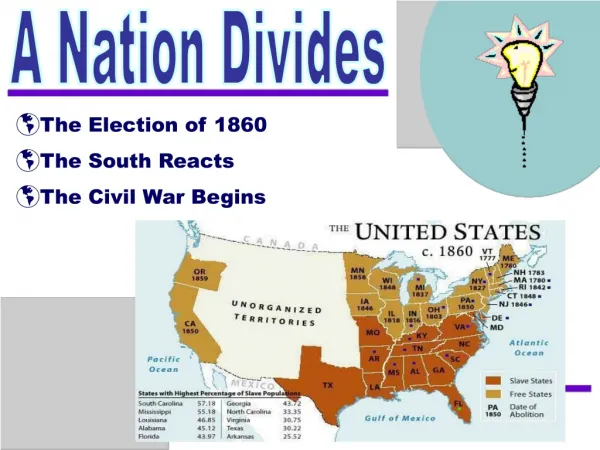
Election of 1860- The Republicans • One of most important election in U.S. History • Republicans nominate Abraham Lincoln • Platform: No expansion of slavery; protection of slavery in South; tariffs to protect Northern manufacturers; federal spending on railways; free homesteads
Election of 1860- The Democrats • Nominate Stephen A. Douglas • Platform: Endorse popular sovereignty; acceptance of any Supreme Court Decision regarding slavery • Southern Democrats believed this was not enough and left the party Stephen A. Douglas, Democratic Nominee
Election of 1860- The Southern Democrats John C. Breckinridge Democratic Party Nominee • Nominate John C. Breckinridge • Platform: Want a federal slave code protecting slavery in South and territories; want North to admit slavery is morally acceptable
Election of 1860- The Constitutional Union Party • Nominate John Bell, a slave holder with moderate views • Accuse other parties of dividing country by only appealing to certain sections • Platform: "to recognize no political principle other than the Constitution...the Union...and the Enforcement of the Laws."
Results • Republicans win every free state except New Jersey • Vote in the slave states is split between Democrats, Southern Democrats and Constitutional Union Party • Republicans win a majority of the electoral college vote despite only getting 40% of the popular vote (2nd least in history) and not even appearing on the ballot in the Southern states