Enhancing Environment Control with Tongue Drive System for Individuals with Physical Impairments
The Tongue Drive System (TDS) is an innovative assistive technology designed for individuals with severe physical impairments, enabling them to control their environments using tongue movements. This system features various command classifications, including right-side and left-side commands, and employs advanced algorithms like Bayesian and KNN classifiers for precise control. Recent human trials involved able-bodied participants from Northwestern University and Georgia Tech, exploring effectiveness in left-side versus right-side classification. Results indicate promising advancements in assistive technology, enhancing autonomy for users.

Enhancing Environment Control with Tongue Drive System for Individuals with Physical Impairments
E N D
Presentation Transcript
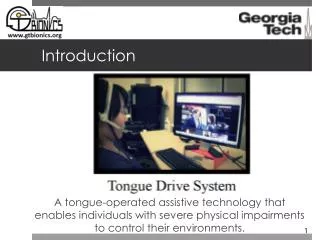
Introduction A tongue-operated assistive technology that enables individuals with severe physical impairments to control their environments.
Tongue Drive System: Hardware 3 4 1 1 2
Tongue Drive System: Commands Right-Side Commands Left-Side Commands TDS Waveforms Samples of each Command TDS Discrete Commands Positions
Terminology • Five Bayesian: • Linear • Dia. Linear • Quadratic • Dia. Quad. • Mahalanobis • Four KNNs: • Euclidean • City Block • Cosine • Correlation • Classifier Combinations • Stacking • Majority Voting (Nine Classifiers) • Assessment • Correctness • Rejection Error • Misclassification Error
Previous Work: mSSP Algorithm Resting Left Up Left Click Resting Right Down Right Click
Methodology • Human Trials Dataset: • Able-bodied subjects from two Universities (4-NUB & 4-GTB) • 8 participants x 5 sessions = 40 experiments ITR Calibration Training Testing
Results and Analysis:First Stage: Left-Side vs. Right-Side Classification NUB = Northwestern University GTB = Georgia Tech 20.1% 2.02%