MLP Conference 2013
420 likes | 562 Vues
The presentation by Ian Cleary from Acuren at the MLP Conference 2013 discusses the application of Spark Optical Emission Spectroscopy (Spark OES) as a rapid and reliable method for determining the carbon equivalent (CE) of steel in pipelines. As pipeline maintenance accelerates, traditional laboratory testing becomes a bottleneck. Spark OES provides an immediate, in-field solution to assess steel chemistry, reducing potential hazards during welding by ensuring compliance with current regulations. The technology promises to enhance safety and efficiency in pipeline operations.


MLP Conference 2013
E N D
Presentation Transcript
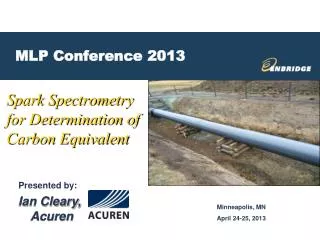
MLP Conference 2013 Spark Spectrometry for Determination of Carbon Equivalent Presented by: Ian Cleary, Acuren Minneapolis, MN April 24-25, 2013
ABSTRACT • As pipeline maintenance and repair activities proceed at a faster and faster pace, the quality control of those repairs must keep pace • Laboratory testing of steel chemistry is a major bottleneck in the process of welding to active pipelines • Spark optical emission spectroscopy offers a fast and reliable way to get accurate chemistry results in the field
SOME HISTORY • Strome, Alberta (February 19, 1985 – 8:00 pm) • Workers caught in the unplanned ignition of leaking LNG from a pipeline they were working on • Fireball 40m across
COLD CRACKING • The leak was caused by cold cracking at a weld in the pipe • Typically occurs at the toe of the weld, in the HAZ (Heat Affected Zone) • Metal in HAZ cools rapidly after welding, which tends to harden the steel and make it more susceptible to hydrogen induced cold cracking.
COLD CRACKING • How hard the steel will become after welding is related to its chemistry • Several elements affect hardenability • Most important elements: carbon and carbon-equivalent (manganese, silicon, nickel, chromium)
CARBON EQUIVALENT (CE) • Low carbon = less likely to harden excessively • High carbon = more likely to harden excessively • Calculating carbon equivalent CE) attempts to estimate how much each element is “worth” in terms of resultant hardenability
CARBON EQUIVALENT • In early days, pipeline industry had few regulations around steel chemistry. • Carbon content guidelines were in place, but other elements were often ignored • Steel chemistry results not stored for future generations
CARBON EQUIVALENT • Welding on these pipes presents potential for serious hazard, if not handled correctly • Regulations now require that carbon equivalent of the existing pipe be known before welding can occur
TESTING CARBON EQUIVALENT • Currently, one way CE can be determined is by testing pipeline shavings in the laboratory. • Small amount of metal shavings are collected from a pipe where welding will happen.
TESTING CARBON EQUIVALENT • Shavings sent back to Acuren laboratory where they are analyzed • Problem: Process takes time (transport + testing + backlog) • With hundreds of samples coming in from hundreds of locations, chemical analysis is a major bottleneck in the pipeline maintenance process
TESTING CARBON EQUIVALENT • Acuren intends to introduce a new method for quickly determining carbon equivalent in the field.
PORTABLE TESTING • A few portable material identification technologies exist, but most have serious limitations. • For example: Positive Material Identification (PMI) is unable to detect carbon
PORTABLE TESTING • Our solution: Spark Optical Emission Spectrometry (Spark OES) • Acuren plans to mobilize spark OES to eliminate the testing bottleneck
SPARK OES • Each element has a characteristic emission line • Spark OES measures chemical composition of metal by igniting a tiny portion of it with a high voltage electric spark • Machine detects emission lines with two sensors: a light optic and an ultraviolet (UV) optic.
SPARK OES • Wavelengths mapped to characteristic emission lines of each element • Machine compares intensity of each emission to a standard, determining the concentration of each element within the sample
SITE PREPARATION • First step (most important): surface preparation • Surface must be clean and flat • Spark OES is highly sensitive – any amount of grease, dust, or contamination will cause incorrect results
SITE PREPARATION • Acuren’s operators trained in proper surface prep procedures:1) Surface buffed down with grinding wheel2) Grinding wheel replace with fresh one3) Surface polished to ensure no contaminants remain • Aluminum oxide or zirconium oxide disks must be used instead of silicon carbide to prevent carbon contamination.
TESTING • Head of probe has a detachable adapter that is the working end of the spark machine • To take a reading, adapter is held against the surface of the sample • Operator presses the trigger • Spark is emitted from an electrode within the adapter
TESTING • Spark penetrates a few hundred μm into the surface and ignites the metal • Surface must be flat so that plasma is contained within the adapter
TESTING • UV spectrum detected in head of probe • Ordinary light spectrum transmitted by fiber optic through probe cable and into main housing of the spark unit • Longest fiber optic cable that can be used is eight meters (past that the light signal becomes degraded with loss of results) • Intensities of the wavelengths are detected and results analyzed by a proprietary algorithm
ANALYSIS & CALIBRATION • Analysis algorithm relies on an automated calibration procedure: “iCalization” or “iCal” • “iCal” works by testing an iCal reference standard – a piece of metal of precisely known composition – at the beginning of a shift, after transportation, or after cleaning
ANALYSIS & CALIBRATION • iCal builds up a library of readings of this standard material that allows machine to compensate for changes in temperature and humidity, vibrating during transport, and minute differences in component placement after cleaning • Adapter thoroughly cleaned after 50 uses • Argon gas is used to flush the machine of water vapor and oxygen before each test.
ANALYSIS & CALIBRATION • To ensure accuracy of readings, a second metal of known composition (the control standard) is tested every time the machine is set up • Unlike iCal the control standard was chosen because composition is very similar to the pipeline that will be analyzed • Second calibration allows operator to determine if spark testing unit is reading accurately in range of interest
PIPELINE TESTING • Acuren has dedicated three of its four TXC03 spark testing units to carbon equivalent evaluation of pipelines digs. • These three machines have been fine tuned to give the most accurate possible results in the expected composition ranges of existing pipes
EXPECTED COMPOSITIONS • Therefore the dedicated spark testing units will yield high accuracy results on any existing line, with special attention to the old pipe.
ON SITE TESTING • Size and weight of the spark machines is a limitation • Each machine has dedicated truck and crew • Each unit mounted on hand truck secured to back of crew cab vehicle • Deploying unit is two-person job, rolling the truck down a ramp onto the ground with the help of a winch • Once on ground, machine can be wheeled to edge of excavation ditch
ON SITE TESTING • Eight meter cable often allows main housing of machine to remain outside ditch • Once powered up the machine is tested on the control standards to verify proper operation and calibration • If test fails the machine is recalibrated with iCal • If iCal fails repeatedly, machine is taken back to shop for examination
ON SITE TESTING • Each spark test crew consists of an operator and experienced non-destructive examination (NDE) technician who know the client’s procedures and requirements • NDE technician performs magnetic particle inspection and ultrasonic testing of proposed test area to ensure polishing is done according to client regulations
ON SITE TESTING • Polishing is performed with 120 grit and will go no deeper than 5-8% of nominal wall thickness • When appropriate test area is located, operator prepares surfaces and performs test • Single spark test consists of at least three readings in same small area
ON SITE TESTING • Operator checks burn marks left by machine as well as consistency of readings to determine if burns were good • Good = black with small white spot at center • Bad = grey or white
ENVIRONMENTAL VARIABLES • Optics must have operating temp. of 36°C • Unit has built in heating system • Extreme cold weather can increase time taken for instrument warming • Acuren’s spark testing machines will be contained within insulated boxes with electric heating pads
ENVIRONMENTAL VARIABLES • Primary screen • Stops working in extreme cold conditions • Machine will need a tent to keep warm and dry while shielding the screen from glare • TX03 comes with app for iPad that allows operator to see results in real time without leaving ditch.
CONCLUSIONS • Spark spectrometry can give fast, accurate results in the field • No longer need to send samples back to lab • Report is printed in PDF format at site.
CONCLUSIONS • Our lab tests show that spark spectrometry can give very consistent readings from one measurement to the next. • With proper calibration and surface preparation, spark spectrometers are a portable way to get results: • Repeatable • Precise • Accurate
SPARK SPECTROMETRY FOR DETERMINATION OF CARBON EQUIVALENTS Presented by Ian Cleary, Acuren MLP Conference 2013