Understanding Circular Motion: Tangential and Rotational Speeds Explained
This document explores the concepts of circular motion, focusing on tangential and rotational speeds. It differentiates tangential speed (linear speed in circular motion) from rotational speed (measured in RPMs). It emphasizes the relationship between radius and speed, where tangential speed changes with radius but rotational speed remains constant. It further discusses centripetal and centrifugal forces, highlighting the latter as a result of inertia. Additionally, the document introduces rotational equilibrium, focusing on the center of gravity (CG) and stability in objects, with insights on methods to find the CG of irregular shapes.

Understanding Circular Motion: Tangential and Rotational Speeds Explained
E N D
Presentation Transcript
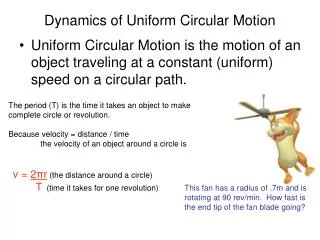
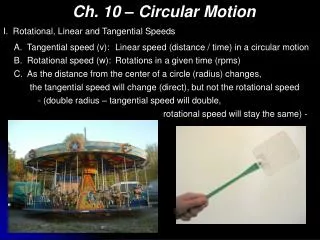
Ch. 10 – Circular Motion I. Rotational, Linear and Tangential Speeds A. Tangential speed (v): Linear speed (distance / time) in a circular motion B. Rotational speed (w): Rotations in a given time (rpms) C. As the distance from the center of a circle (radius) changes, the tangential speed will change (direct), but not the rotational speed - (double radius – tangential speed will double, rotational speed will stay the same) -
II. Centripetal Force: Force that causes objects to move in a circular path III. Centrifugal Force: Within a system, the force felt toward the outside of a circle… NOT A TRUE FORCE, It’s actually Inertia!!! A spinning space station could be used to simulate gravity in space!!!
Ch. 11 – Rotational Equilibrium When objects are thrown through the air, they will rotate around the CG I. Center of Gravity (CG) or Center of Mass: The average position of weight or mass of an object II. Stability: CG must be over an object’s base to be stable… Objects will tip over and fall to lower (and stabilize) their CG A. Changing the CG: Objects tend to lower their CG, raising it requires work B. An iceberg’s CG will be far below the surface C. CG of people: Generally higher for men than women… Use a plumb bob to find CG of irregular objects!