Truth tables FOR CONDITIONALS & BiConditionals
170 likes | 303 Vues
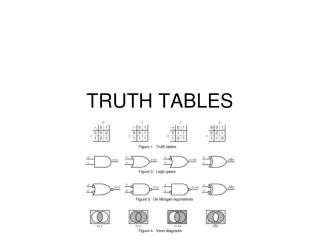
This guide provides a detailed overview of truth tables for conditionals and biconditionals, focusing on the concepts of negation, conjunction, and disjunction. It explains how a conditional statement is structured (If p, then q) and illustrates how to construct truth tables for various logical statements. Key examples highlight when these statements are true or false, including tautologies and self-contradictions. Practice problems and a review schedule support your understanding and preparation for tests. Master the basics of logic to excel in your studies!


Truth tables FOR CONDITIONALS & BiConditionals
E N D
Presentation Transcript
Truth tables FOR CONDITIONALS & BiConditionals Parts of Sections 3.4 and 3.2
REVIEW • Is a statement with the opposite truth value from the original statement • Is denoted with or ~ • Includes the word “not” when read Negation
REVIEW Negation Truth Table Need to memorize the basic truth tables!
REVIEW Connectives
REVIEW means OR Disjunction Truth Table Disjunction is true if either or both are true.
REVIEW means AND Conjunction Truth Table Conjunction is true only if both are true.
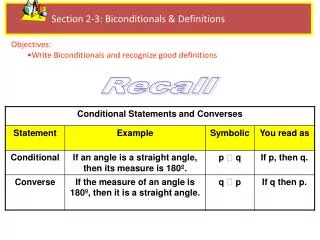
Conditional Statement If p then q. If p, q. Conditional IF…THEN… hypothesis or antecedent conclusion or consequent
Example: Example: Write pq. Now write qp. p: Ed is a poet. q: Ed is a writer. pq: If Ed is a poet, then he is a writer. qp: If Ed is a writer, then he is a poet.
Truth Table If…then… Conditional If the hypothesis is false, then the conclusion can be anything. p: I live in Brighton. q: I live in Tennessee. p: An alien gave me $1 million. q: I would buy a miniature giraffe. A conditional is false only if True False.
Example: Construct the truth table Construct a truth table for ~q ~p.
Example: Construct the truth table Construct a truth table for [( p q ) ~p] q.
Example: Construct the truth table Tautology – compound statement that is always true Self-contradiction – compound statement that is always false, like p ~p
Example: Construct the truth table Construct a truth table for ( p q) r.
Example: Construct the truth table Construct a truth table for ( p q) ( q p). This is the definition of a biconditional. A biconditional is true only if both parts have the same truth value.
Biconditional means IF AND ONLY IF BiconditionalTruth Table A biconditional is true only if both parts have the same truth value.
Practice Problems From the Cow book 3.1 pg 93 # 1 – 15 odd, 17 – 24 all, part b only for 29 – 35 odd, 37, 38 3.2 pg 101 # 1 – 8 all, 25 – 28 all, 35, 39, 43 3.3 pg 113 # 1 – 11 odd, 15 – 35 every other odd 3.2 pg 101 # 9 – 16 all, 29 – 32 all, 45 – 51 odd 3.4 pg 124 # 1 – 57 every other odd 3.5 pg 136 # 1 – 5 odd, 9 – 73 every other odd, 77 Schedule Tue, 10/2 Equivalent Statements, Review Thurs, 10/4 Test on Chapter 3 Then, FALL BREAK!