Download
1 / 23
230 likes | 356 Vues
This paper explores real-time traffic scheduling in Wireless Local Area Networks (WLANs) amidst unpredictable channel errors, emphasizing QoS degradation and scheduling algorithms. We present a detailed analysis of the challenges posed by wireless channel errors affecting transmission deadlines, proposing a real-time scheduling framework that balances fairness and throughput. Key scheduling algorithms, including EDF and GDF, are analyzed through simulations to evaluate their performance under variable error conditions. The study aims to enhance real-time communication in packet transmission while maintaining acceptable loss rates.

E N D
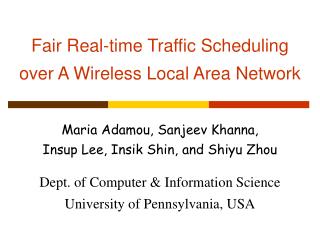
Fair Real-time Traffic Scheduling over A Wireless Local Area Network Maria Adamou, Sanjeev Khanna, Insup Lee, Insik Shin, and Shiyu Zhou Dept. of Computer & Information Science University of Pennsylvania, USA
Real-time Communication over Wireless LAN MH1 BS MH2 MH3
IEEE 802.11 – standard DCF (distributed) Contention-based transmission PCF (centralized) Contention-free (CF) transmission BS schedules CF transmissions by polling Wireless LAN MAC Protocol
Unpredictable Channel Error location dependent bursty Wireless Network Characteristics MH1 BS MH2 MH3
Challenges • How do channel errors affect real-time transmissions? • QoS degradation • Wireless channel error model • How does BS schedule real-time transmissions with unpredictable errors? • Real-time scheduling objective considering QoS degradation with errors • Real-time scheduling algorithm
Outlines • Real-time traffic model • Scheduling objectives • Theoretical results • Online scheduling algorithms • Simulation results • Conclusion
Real-time Traffic Model • Periodic packet generation (release time) • Soft deadline • Upon missing deadline, a packet is dropped • Acceptable packet loss (deadline miss) rate • Degradation = actual loss rate – acceptable loss rate • The same packet length (execution time)
Scheduling objectives 1. Fairness (considering each flow) • Location dependent channel errors • Minimizing the maximum degradation 2. Throughput (considering the system) • Maximizing the overall system throughput (fraction of packets meeting deadlines) • Online scheduling algorithm • without knowledge of error in advance
Theoretical results • No online optimal algorithm • Performance ratio of an online algorithm w.r.t. optimal • for throughput maximization, two • for achieving fairness, unbounded • For the combined objectives, unbounded • A polynomial time offline algorithm that optimally achieves our scheduling objectives
Online scheduling algorithms • EDF (Earliest Deadline First) • GDF (Greatest Degradation First) • EOG (EDF or GDF) • LFF (Lagging Flows First)
εi Di 0.2 0.4 0.3 0.1 3 4 3 1 EDF Queue EDF (Earliest Deadline First) when a new packet is available when it dispatches Scheduler
εi Di 0.2 0.1 0.3 0.4 3 1 3 4 GDF Queue GDF (Greatest Degradation First) when a new packet is available when it dispatches Scheduler
0.2 0.4 0.3 0.1 0.4 0.3 0.1 3 1 4 1 3 4 3 EDF Queue GDF Queue EOG (EDF or GDF) when a new packet is available If there is a packet that will miss its deadline after next slot when it dispatches Scheduler Otherwise
εi Di 0.2 3 0.4 0.3 0.1 1 3 4 LFF (Lagging Flows First) when a new packet is available index 4 3 2 1 LFF Array
εi Di 0.2 3 0.2 0.3 0.4 0.1 1 3 4 3 LFF (Lagging Flows First) when a new packet is available index 4 3 2 when it dispatches 1 Scheduler LFF Array
0.2 0.4 0.3 0.1 0.4 0.3 0.1 2 1 4 1 2 4 3 EDF Queue GDF Queue LFF (Lagging Flows First) when a new packet is available If there is a packet that will miss its deadline after next slot when it dispatches Scheduler Otherwise
Simulation – Performance Metrics • Degradation (for each flow) • Fraction ofpackets lostbeyond the acceptable packet loss rate • Throughput (over all flows) • Fraction of successfully transmitted packets
MH1 Simulation – Error Modeling • Random blackouts (wi) for error period • Error duration rate = t0 tmax wi MH1 BS MH2 MH3 MH2 MH3
Related Work • QoS guarantees over wireless links • No consideration of fairness issue • WFQ over wireless networks • No consideration of deadline constraint • QoS degradation considering deadline • Imprecise computation • IRIS (Increased Reward with Increased Service) • (m,k)-firm deadline model • DWCS (Dynamic Window-Constrained Scheduling)
Conclusion • Scheduling objectives • Fairness – minimizing the maximum degradation • Overall throughput maximization • Theoretical results • No online algorithm can be guaranteed to achieve a bounded performance ratio for the scheduling objective
Conclusion • Online algorithms • For fairness objective 1. LFF2. GDF3. EOG4.EDF • For maximum throughput objective 1. EDF2. LFF3. EOG4.GDF • Future work • Variable length packets • Other measures of fairness