The Evolution and Structure of Ancient Greek Theatres
Explore the history and architecture of ancient Greek theatres from the 4th to the 6th century B.C. Discover how these outdoor semi-circular structures were designed to enhance the audience's experience. Learn about the four major components of a basic Greek theatre: Theatron (seating area), Skene ( backdrop), Orchestra (performance space), and Parados (entrance/exit). Examine the evolution of seating with cushions and marble seats used by audiences and get insights into the complex structures that developed over time.

The Evolution and Structure of Ancient Greek Theatres
E N D
Presentation Transcript
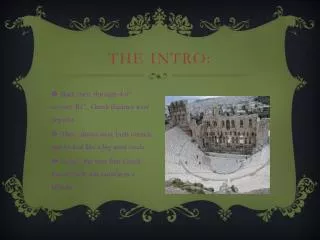
The Intro: • Back then, through 4-6th century B.C., Greek theatres were popular. • They always were built outside and looked like a big semi-circle. • In fact, the very first Greek theatre built was outside in a hillside.
The Structures: • For a basic Greek theatre, there are four major components: • Theatron, Skene, Orchestra, and Parados. • However, for a more complicated theatre, they have more than 4 components; sub components. -A simple Greek theatre’s stucture.
Theatron: • The term for theatron was “viewing-place”. • Basically where the audience sits to watch the plays • Around the 5th century B.C., the audience uses cushion or boards, but later around the 4th century B.C, they had marbles seats. • Parts of the theatron are diazoma and koilon. • Koilon
Diazoma • Diazoma consists A and B