Image Restoration Techniques in Observational Astrophysics II
140 likes | 247 Vues
Learn how to optimize information extraction from images through methods like Maximum Likelihood Algorithm. Study spectroscopic and photometric observations reduction, image restoration, and nightly planning. Understand the fundamentals and practical applications in data reduction. Visit the website for more information.


Image Restoration Techniques in Observational Astrophysics II
E N D
Presentation Transcript
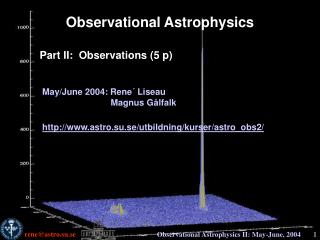
Observational Astrophysics II (L3) • What do want to do? • Nightly planning overwiew • Reduce spectroscopic observations • Reduce photometric imaging observations • Perhaps, `massage´ our images http://www.astro.su.se/utbildning/kurser/astro_obs2/ Observational Astrophysics II: May-June, 2004
http://www.not.iac.es/observing/cookbook Observational Astrophysics II: May-June, 2004
23:30 01:15 03:00 07:00 19:00 Grupp 1 + Alla ->23:30 Grupp 3 ->03:00 Grupp 2 ->01:15 Grupp 4 + Alla? 7 h a-natt => 1h45m/ grp n-tid Observational Astrophysics II: May-June, 2004
Data Reductions neither from theoretical nor from reduction point of view any fundamental difference between Spectroscopic image frames Photometric image frames Observational Astrophysics II: May-June, 2004
Correct for / obtain from multiple image frames: • IRAF • Bias imarith • Dark current • Hot/cold columns • Sky background • Cosmic Rays imcombine • Flat Field • Photometric calibration apphot • Spectrometric calibration identify • rectify spectrum in spatial domainlongslit – fitcoords, transform • extract spectrum noao.twodspec.apextract – apall • measure lines (Gaussian fitting) splot • slit losses sbands Observational Astrophysics II: May-June, 2004
Image restauration techniques How to recover the information in an `image´ or, actually, How to optimise the information extraction Observational Astrophysics II: May-June, 2004
Image restauration techniques I is the observed image, which is a function of the angle vector q, and I equals the convolution of the object O with the filter function T. cumbersome simple An equivalent expression is the product of the Fourier Transforms o and t. To derive the object O, one would simply divide i by t and transform back. Observational Astrophysics II: May-June, 2004
Image restauration techniques In practice, this involves division by zero (or very small numbers) and therefore is impractical numerically. One way out are suggestions like: Jan Högbom, em. Stockhom Observatory CLEAN Maximum Entropy Method (MEM) Maximum Likelihood Method Inversion techniques use conditions like: Source has positivity Source has bounded support Observational Astrophysics II: May-June, 2004
Image restauration techniques • Maximum Entropy Method (MEM) / Maximum Likelihood Method • Most probableobject O is that which • Is most consistent with observed image I • Uses least extra information Image `entropy´ is a function which is maximal when image contains minimal (extra) information: max Entropy for Equilibrium min Information Observational Astrophysics II: May-June, 2004
Example: Maximum Likelihood Algorithm (modified Richardson-Lucy) input undersampled observations Restored Image + Noise source positions ? Observational Astrophysics II: May-June, 2004
test case Iteration Number 0 = start value 1 2 3 done! 4 5 Larsson et al. 2000, Astron. Astrophys. 363, 253 Observational Astrophysics II: May-June, 2004
Before we go to the mountain... don´t forget http://www.not.iac.es/observing/cookbook Observational Astrophysics II: May-June, 2004
... och nu en liten övning: Slut ögonen och tänk dig att du närmar dig teleskopdomen... Beskriv (i telegramstil) vad du gör härnäst – steg för steg när du nu ska observera med NOT • numrera gärna stegen • lämna gärna mellanrum mellan stegen • vi kommer att jämföra i realtid och fylla i vid behov glöm inte att skriva ditt namn Observational Astrophysics II: May-June, 2004