Download
1 / 11
110 likes | 236 Vues
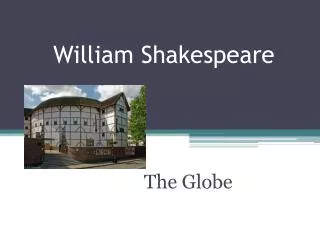
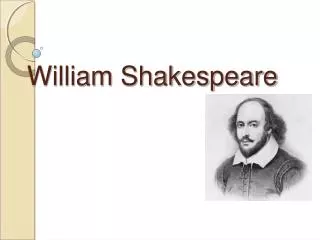
William Shakespeare, born in 1564 and passing in 1616, was a defining figure of English literature during the reigns of Elizabeth I and James I. His multifaceted career as an actor, playwright, and part-owner of the Lord Chamberlain’s Men flourished at The Globe Theatre. Shakespeare's output includes 37 plays, differentiating into tragedies such as "Macbeth", comedies like "A Midsummer Night’s Dream", and histories such as "Henry V". Exploring themes of tragic heroes, flaws, and supernatural elements, his works resonate deeply with human experience.

E N D
biography • Born in 1564 • Died: April 23, 1616 • His career was during the times in which Elizabeth I and James I were in throne. (ruled 1558-1625) • He began his career as an actor, writer, and part owner of the play company, Lord Chamberlain’s Men. • Wrote 37 plays and 154 sonnets • His plays were performed in The Globe Theatre
The Three Main Categories • His plays consisted of: • Tragedies • Comedies • Histories • Examples: • Tragedies: Macbeth, Hamlet, Romeo and Juliet • Comedies: A Midsummer Night’s Dream and The Winter’s Tale • Histories: King John, Richard II, and Henry V
Macbeth • Example of a Tragedy • Written in 1606 during James I ruling • Shortest and bloodiest of all his plays. • Shakespeare paid homage to the King’s Scottish lineage with Macbeth
Elements of a Tragedy • Element # Juan: The Tragic Hero • There is usually only 1 tragic hero, except in love tragedies. • Only great men are Tragic Heroes • Qualities: • exceptional beings. • destructive • do not have to be “good”, but they usually are. • live for what seems to be a type of the mystery of the whole world. • Example of Tragic Heroes are: Hamlet and Macbeth
Element Numero Two: The Tragic Flaw • An obsessive flaw that leads to the downfall of the tragic hero/heroine. • Examples: • Ambition • Greed • Hunger for power • Manipulative • Hypocrisy
Element # 3: The Tragic Story • The tragic story leads up to, and includes, the unusual and exceptionally disastrous death of the hero. • Shakespeare’s tragic heroes are responsible and the center of their disasters and falls.
Element # 4: The Abnormal, The Supernatural, Fate/Fortune/Chance • Shakespeare occasionally presents abnormal conditions of the mind: insanity, hallucinations, etc. • The supernatural: ghosts and witches.
Element # 5: Tragic Conflicts • The action of the tragic hero is most often motivated by external and internal conflicts that keeps being added on to. (Snowball effect) • External Conflict • There are usually 2 people or 2 groups involved in conflict. • One is always the tragic hero. • Internal Conflict • Shakespeare’s tragic hero is at some point torn by inward struggle. • The conception of outer and inner struggle includes the action of “spiritual forces”.
Element # 6: The Tragic Pattern • The main character is presented to us as someone of power: a king, a prince, a general. • Then the obsessive flaw of the characteris presented within the first two acts. • Urgencies and conflicts begin to arise. • Misreading and rationalizations occur. • Murder, exile, alienation of enemies and allies are brought on by new conflicts. • Gradual isolation of the Tragic Hero.
Element # 7: Tragic Structure in the Plays A tragedy represents a conflict which ends in disaster, which can be divided into 7 parts. • Exposition: The general atmosphere, time, place, main characters, and opening conditions of the play. • Initiating Incident: The event or action that starts the conflict and action of the play. • Rising Actions: This is a series of actions involving the hero usually covering more than one act. • Climax: distinct change occurs within the character • Falling Actions: The conflict between the protagonist and the antagonist becomes the essence of the play. • Moment of Final Suspense: It is the moment when things begin to look as if they will go the way of the protagonist again. • Catastrophe: This is the complete downfall of the protagonist, either through death or some other devastating circumstance.