Understanding Chemical Kinetics: Reaction Rates, Temperature Effects, and Mechanisms
This chapter explores the fundamentals of chemical kinetics, emphasizing the rates of chemical reactions and the influence of various factors, particularly temperature. It covers key concepts such as rate expressions, initial rates, slope analyses, and integrated rate equations for zero, first, and second-order reactions. Additionally, the chapter delves into the effects of catalysts, activation energy, and the Arrhenius equation. Through exercises and graphical methods, students gain insights into reaction mechanisms, molecularity, and the importance of kinetic data in supporting or disproving proposed mechanisms.

Understanding Chemical Kinetics: Reaction Rates, Temperature Effects, and Mechanisms
E N D
Presentation Transcript
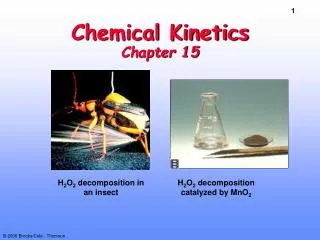
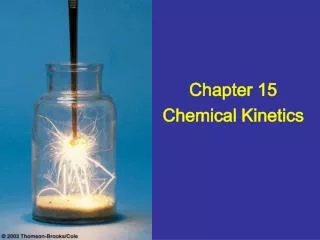
Chapter 15 Chemical Kinetics
Rate Expression Initial Rate Slope of the tangent line
Exercise 2 2 NO(g) + 2 H2(g) N2(g) + 2 H2O(g)
Integrated Rate Expressions Plot for shape of rate response Use in graphical methods
First Order Rate Expression Conc Vs Time
Second Order Rate Expression Conc VS Time
Effect of Temperature on the Rate Constant Increasing Concentration
The Reaction Coordinate dAB AB A + B A A A B B B
Catalytic Hydrogenation CH2=CH2 + H2 CH3-CH3
The Bimolecular Substitution Reaction [Br····CH3····Cl]- BrCH3
The Unimolecular Substitution Reaction [CH3]+ BLOCK + Br- + [CH3]+ BrCH3
The Unimolecular Mechanism Requires an Intermediate This reaction has two transition states
Exercise 4 Slope=-k = -1.244 min-1
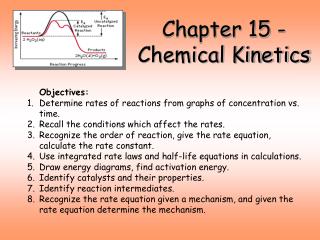
Concepts from Chapter 15 • Rate constants • Rate laws • Integrated rate equations • Zero-order, first-order and second-order reactions • Half life, t1/2 • Collision theory • Activation energy and the Arrhenius equation(s) • Catalysts • Reaction co-ordinates, intermediates and transition states • Reaction mechanisms and elementary steps • Molecularity - rate equations for elementary steps • Rate determining steps • Supporting/disproving a proposed mechanism using kinetic data