Global Primary Allocation for Radiodetermination Satellite Service in 2,483.5-2,500 MHz Band
This agenda item discusses the proposal for a global primary allocation for the Radiodetermination Satellite Service (RDSS) in the 2,483.5-2,500 MHz band. Presenter Geoff McMillen highlights the need to extend existing allocations and determine necessary regulatory provisions based on ITU-R study results and Resolution 613 (WRC-07). Key considerations include maintaining coordination threshold values and protecting existing services, while supporting coordination for MSS systems and addressing outcomes relevant to Australia. The conclusion aims for an effective global RDSS allocation while assessing potential impacts on future coverage.

Global Primary Allocation for Radiodetermination Satellite Service in 2,483.5-2,500 MHz Band
E N D
Presentation Transcript
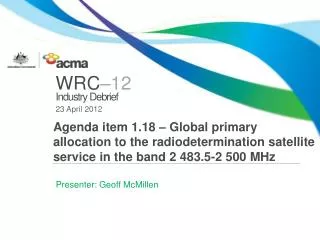
Agenda item 1.18 – Global primary allocation to the radiodetermination satellite service in the band 2 483.5-2 500 MHz Presenter: Geoff McMillen
Background to consider extending the existing primary and secondary radiodetermination-satellite service (space-to-Earth) allocations in the band 2 483.5-2 500 MHz in order to make a global primary allocation, and to determine the necessary regulatory provisions based upon the results of ITU‑R studies, in accordance with Resolution 613 (WRC-07)
Australian positions support a worldwide primary RDSS (space-to-Earth) allocation. support the Method in the CPM Report. Retain coordination threshold values in RR Appendix 5 for MSS systems (in the absence of studies showing existing services will be adequately protected).
Meeting considerations pfd for MSS and RDSS grandfather existing filings Protection for Russian RLS
Outcomes relevant to Australia Global primary RDSS allocation RDSS pfd threshold values Increased MSS pfd threshold values Grandfathered RDSS filings
Outcome regulatory provisions relevant to Australia Article 5: add footnote 5.B118 modify 5.446 delete 5.400 Appendix 5: add Note X to Table 5-2 (pfd thresholds for RDSS and MSS)
Additional Note in Appendix 5 NOTE X –Instead of the values in the Table, the pfd coordination thresholds of −142.5 dB(W/m2) in 4 kHz and −124.5 dB(W/m2) in 1 MHz for the MSS and −152 dB(W/m2) in 4 kHz and −128 dB(W/m2) in 1 MHz for the RDSS shall apply in.....Australia.....(approx 80 administrations)
Conclusion Australia’s primary objective of a global RDSS allocation was achieved. Retention of originally proposed RDSS pfd and existing MSS pfd levels was not achieved.
Follow up action Reflect the outcome in the ACMA Spectrum Plan and Outlook. Assess grandfathered RDSS filings with high pfd for potential to compromise future Galileo coverage of Australia.
WRC-12 AI 1.18 END