Solving Voltage and Charge Movement Problems in Electric Fields
Explore the intricacies of electric potentials and work done in moving point charges within an electric field. We tackle problems involving a 6 µC charge being brought from infinity to various positions relative to two +1.5 µC charges, calculate initial and final voltages, and determine the work required for such movements. Key formulas like ( V = k cdot q / r ) and energy change calculations are employed. We also analyze situations with both positive and negative charges to find voltage at specific points and the energy needed for charged particle movements.

Solving Voltage and Charge Movement Problems in Electric Fields
E N D
Presentation Transcript
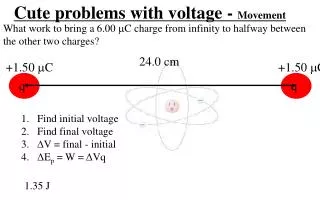
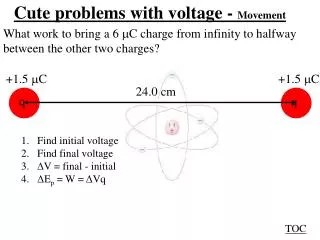
Cute problems with voltage - Movement q q What work to bring a 6 C charge from infinity to halfway between the other two charges? +1.5 C +1.5 C 24.0 cm • Find initial voltage • Find final voltage • V = final - initial • ΔEp = W = ΔVq TOC
Cute problems with voltage q q +1.5 C +1.5 C 12.0 cm 12.0 cm • Voltage at midpoint due to one of charges: • V = kq = k(1.5x10⁻⁶) = 112,400 V • r .12 • Total potential is twice that: = 224,800 V • V = w/q • The charge is then released. What is its velocity when it is far away if it has a mass of 12 grams? (.012 kg) • Vq = 1/2mv2 TOC
q q q q q q +1.5 C +1.5 C +6 C 16.0 cm 8.0 cm What work to bring a 6 C charge from halfway between the other two charges to 8.0 cm from the left charge? +6 C +1.5 C +1.5 C 24.0 cm • Find initial voltage • Find final voltage • V = final - initial • ΔEp = W = ΔVq TOC
Try this one q q q What work to bring a 13.0 C charge from halfway between the other two charges to 6.0 cm from the positive and 18 cm from the negative? +3.20 C +13.0 C -4.10 C 12.0 cm 12.0 cm Initial V -67425 V Final V 274700. V Change in V 342100. V Work 4.448 J TOC +4.4 J
Each grid is a meter. If charge A is -14.7 μC, and charge B is +17.2 μC, calculate the voltage at points g and h, and the amount of work needed to move a +3.40 μC charge from g to h. A B y Vg = kq/r + kq/r = k(-14.7E-6)/√(12+22) + k(17.2E-6)/√(12+52) = -28775.6 V Vh = kq/r + kq/r = k(-14.7E-6)/√(72+32) + k(17.2E-6)/√(52+02) = 13573.1 V ΔV = Vh – Vg = 42348.6 V W = ΔEp = ΔVq = (42348.6 V)(+3.40E-6 C) = 0.14399 J ≈ 0.144 J g x h 0.144 J