Calculation of Supplementary Feed for Milk Production and Nutrient Management
60 likes | 184 Vues
This guide provides a comprehensive method for formulating supplementary feed to optimize milk production. It details the nutritional requirements of 1 liter of milk, including energy, crude protein, calcium, and phosphorus content. Using specific calculations, we determine the protein-to-calorie ratio (PCR) of various energy sources and how much protein concentrate should be added to achieve the required nutrient profile. This guide also addresses calcium and phosphorus levels, offering solutions for supplementation. Suitable for dairy farmers and nutritionists focused on enhancing milk yield.


Calculation of Supplementary Feed for Milk Production and Nutrient Management
E N D
Presentation Transcript
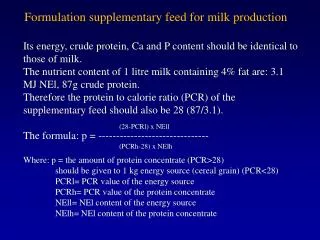
Its energy, crude protein, Ca and P content should be identical to those of milk. The nutrient content of 1 litre milk containing 4% fat are: 3.1 MJ NEl, 87g crude protein. Therefore the protein to calorie ratio (PCR) of the supplementary feed should also be 28 (87/3.1). (28-PCRl) x NEll The formula: p = ------------------------------- (PCRh-28) x NElh Where: p = the amount of protein concentrate (PCR>28) should be given to 1 kg energy source (cereal grain) (PCR<28) PCRl= PCR value of the energy source PCRh= PCR value of the protein concentrate NEll= NEl content of the energy source NElh= NEl content of the protein concentrate Formulation supplementary feed for milk production
Formulation supplementary feed for milk production Example: d.m. NEl c. protein. Ca P NEl c. protein Ca P PCR (g/kg) (MJ/kg d.m.) (g/kg d.m.) (MJ/kg) (g/kg) corn 912 8.57 103 0.2 3.5 7.82 94 0.18 3.2 12 extr. sunflower meal 896 6.38 412 2.3 10.3 5.72 369 2.1 9.2 64.5 (28-12) x 7.82 p = ----------------------- = 0.6 (64.5 – 28) x 5.72 So, 0.6 kg sunflower meal has to be given to 1 kg corn. 1 kg corn + 0.6 kg sunflower = 1.6 kg; 1/1.6 = 63% corn 0.6/1.6 = 37% sunflower
Formulation supplementary feed for milk production How much should be given from this feed for one litre milk? NEl crude protein Ca P (MJ) (g) (g) (g) 0.63 kg corn 4.93 59 0.11 2.0 0.37 kg sunflower 2.12 137 0.78 3.4 In 1 kg feed 7.05 196 0.89 5.4 Needed for 1 litre milk 3.1 87 2.8 1.7 So for 1 litre milk 3.1/7.05; or 87/196 = 0.44 kg feed needed Controlling the Ca and P levels Ca (g) P (g) 1kg feed contains 0.89 5.4 0.44 kg feed 0.39 2.37 requirement : 2.8 1.7 The 2.41 g calcium deficit can be supplemented by limestone. 1kg limestone contains 380g Ca (see the table). So, for supplementing 1 g Ca 2.6 g limestone (1000/380) should be given. So, to 0.44 kg feed 6.27 g (2.41 x 2.6) limestone should be given. Each kg of feed needs 14.25 g (6.27/0.44) limestone supplementation.
Exercise Prepare supplementary feed for milk production using wheat and soybean meal! The milk contains 4% fat and 3.3% protein. How much needed from this feed for one litre milk? Control the Ca and P level of the feed, use supplementation if needed! d.m. NEl c. protein. Ca P NEl c. protein Ca P PCR (g/kg) (MJ/kg d.m.) (g/kg d.m.) (MJ/kg) (g/kg) wheat extr. soybean meal
Exercise How much should be given from this feed for one litre milk? NEl crude protein Ca P (MJ) (g) (g) (g) kg wheat kg soybean In 1 kg feed Needed for 1 litre milk So for 1 litre milk ............................................................kg feed needed Controlling the Ca and P levels Ca (g) P (g) 1kg feed contains .............. kg feed requirement : 2.8 1.7
Exercise A 650 kg weight milking cow, kept in medium quality pasture, produce milk with 3,8% fat and 3,3% protein. The daily ration contains the following nutrients: dry matter : 16,5 kg NEl 105,5 MJ crude protein: 2133 g crude fibre: 3135 g How much milk can be produced from this ration?