TeraGrid: Uniting Open Scientific Research with Advanced Distributed Cyberinfrastructure
TeraGrid is the world’s largest distributed cyberinfrastructure, fostering open scientific research through support from the US NSF. With over 1.6 PF of high-performance computing (HPC) and more than 27,000 high-throughput computing (HTC) CPUs, TeraGrid provides over 3 PB of disk storage and over 60 PB of tape resources. The platform encourages innovative research using workflows, coupled simulations, remote visualization, and community engagement via Science Gateways. TeraGrid integrates various tools, systems, and services, promoting accessibility and collaboration in computational science.

TeraGrid: Uniting Open Scientific Research with Advanced Distributed Cyberinfrastructure
E N D
Presentation Transcript
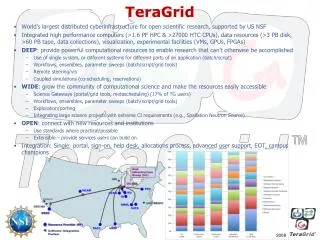
TeraGrid • World’s largest distributed cyberinfrastructure for open scientific research, supported by US NSF • Integrated high performance computers (>1.6 PF HPC & >27000 HTC CPUs), data resources (>3 PB disk, >60 PB tape, data collections), visualization, experimental facilities (VMs, GPUs, FPGAs) • DEEP: provide powerful computational resources to enable research that can’t otherwise be accomplished • Use of single system, or different systems for different parts of an application (batch/script) • Workflows, ensembles, parameter sweeps (batch/script/grid tools) • Remote steering/vis • Coupled simulations (co-scheduling, reservations) • WIDE: grow the community of computational science and make the resources easily accessible • Science Gateways (portal/grid tools, metascheduling) (17% of TG users) • Workflows, ensembles, parameter sweeps (batch/script/grid tools) • Exploration/porting • Integrating large science projects with extreme CI requirements (e.g., Spallation Neutron Source) • OPEN: connect with new resources and institutions • Use standards where practical/possible • Extensible – provide services users can build on • Integration: Single: portal, sign-on, help desk, allocations process, advanced user support, EOT, campus champions 2008