Download
1 / 1
10 likes | 139 Vues
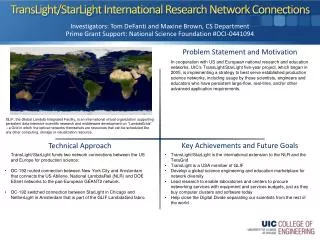
The TransLight/StarLight project, initiated in 2005, is a collaborative effort directed by Tom DeFanti and Maxine Brown at the University of Illinois at Chicago, funded by the National Science Foundation. This five-year initiative connects the US and European research and education networks, focusing on supporting scientists, engineers, and educators requiring high-capacity real-time data flows. With connections like the OC-192 routed link between New York and Amsterdam, TransLight/StarLight plays a crucial role in bridging the digital divide and enabling data-intensive scientific collaboration across borders.

E N D
TransLight/StarLight International Research Network Connections Investigators: Tom DeFanti and Maxine Brown, CS Department Prime Grant Support: National Science Foundation #OCI-0441094 In cooperation with US and European national research and education networks, UIC’s TransLight/StarLight five-year project, which began in 2005, is implementing a strategy to best serve established production science networks, including usage by those scientists, engineers and educators who have persistent large-flow, real-time, and/or other advanced application requirements. GLIF, the Global Lambda Integrated Facility, is an international virtual organization supporting persistent data-intensive scientific research and middleware development on “LambdaGrids” – a Grid in which the optical networks themselves are resources that can be scheduled like any other computing, storage or visualization resource. • TransLight/StarLight funds two network connections between the US and Europe for production science: • OC-192 routed connection between New York City and Amsterdam that connects the US Abilene, National LambdaRail (NLR) and DOE ESnet networks to the pan-European GÉANT2 network. • OC-192 switched connection between StarLight in Chicago and NetherLight in Amsterdam that is part of the GLIF LambdaGrid fabric • TransLight/StarLight is the international extension to the NLR and the TeraGrid • TransLight is a USA member of GLIF • Develop a global science engineering and education marketplace for network diversity • Lead research to enable laboratories and centers to procure networking services with equipment and services budgets, just as they buy computer clusters and software today • Help close the Digital Divide separating our scientists from the rest of the world