Download
1 / 12
120 likes | 245 Vues
The expansion of railroads in the 19th century led to significant changes in the economy and competition. Small independent rail lines struggled to survive against larger companies that engaged in consolidating practices. These giants offered rebates that forced smaller players out of business and created shipping pools, raising costs for farmers. Despite this, railroads fueled job creation and spawned the steel industry, as innovations like the Bessemer Process improved railroad construction. Figures like Andrew Carnegie emerged, advocating for philanthropy while monopolizing resources through horizontal integration.

E N D
Eliminating Competition with Railroads • Small, independent lines were $$ to run, many began to consolidate • consolidate: ______________________ • (larger buys smaller OR forces them out of business)
Eliminating Competition with Railroads • Large r&r companies offered rebates • rebates: __________________________________________________________________________ • forced many smaller companies out of business • hurt small shippers (farmers)
Eliminating Competition with Railroads • Large r&r companies try to help each other out by • Eliminating the small companies • Creating pools • pools: ________________________________________________________________________________________________________________________________________________
Pools - This hurts farmers as it keeps shipping prices high • Sometimes farmers burned crops for fuel to drive • Populist party re-emerges & calls for gov’t regulation of rail rates • R&R companies simply bribed politicians to avoid changing rules
Railroads Fuel the Economy • Creates thousands of jobs • ________________ turn iron to steel for tracks/ engines • _________________ make railroad ties • ________________ use coal to fuel engines • R&R companies employ workers – laid track, built trestles, carved tunnels, built stations
Railroads Fuel the Economy • New ways of managing business • Create special departments for shipping/ accounting/ servicing equipment • Expert managers followed by ______________________________ (trickle down) RAILROADS OPEN THE COUNTRY TO GROWTH • Brings people in the expanded West together • Allows new businesses to boom • Allows towns to spread • Creates a network for the country
Growth of Steel Industry Growth of railroads spark growth of steel industry • Early trains – ___________ rails (wore out quickly) • _____________– much stronger/ not likely to rust • Problem: expensive/ difficult to make
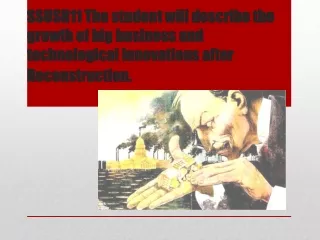
Bessemer Process • 1850s • __________________________________________________________________________ • Railroads: steel rails • Builder: nails, screws, needles • Architects: steel supports for skyscrapers Steel mills pop up all over the country & bring pollution
Carnegie’s Empire Now controlled all phases of the steel industry - ____________– iron ore - ____________– create the steel - Railroads – laying iron track & shipping finished product - _________________– shipping finished product
___________________________ a single manufacturer controls all of the steps used to change raw materials into finished products Horizontal Integration “___________________” – consolidating companies to monopolize an industry
Monopoly a single owner or company COMPLETELY controls the ________________of a product/ industry
Carnegie • Believed that the rich had a duty to help the poor & improve society • This idea: “The Gospel of wealth” (gives millions $$ to charities) • Sells steel empire in 1901 & spends rest of time/$$ helping people