Cardiovascular System
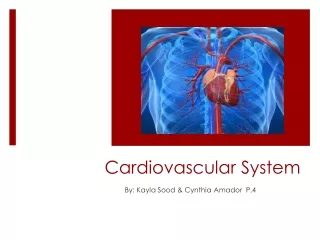
The cardiovascular system, also known as the circulatory system, is essential for pumping blood throughout the body. It delivers oxygen to tissues while helping to eliminate carbon dioxide. De-oxygenated blood flows into the heart via the Superior and Inferior Vena Cava, moves through the Right Atrium and Ventricle, and is pumped to the lungs for oxygenation. Oxygen-rich blood returns to the heart and is then circulated throughout the body. On average, an adult has about 5 liters of blood and over 60,000 miles of blood vessels.


Cardiovascular System
E N D
Presentation Transcript
Cardiovascular System By: Savannah Walker and MadisyneBraden
Functions • The cardiovascular system, aka the circulatory system, pumps blood throughout the body. While doing so, the blood gives oxygen to the body and in the process other organs help to rid of carbon dioxide.
How It Works • De-oxygenated blood enters the the heart through the Superior and Inferior Vena Cava. • Blood enters the Right Atrium • Blood enters the Right Ventricle by Tricuspid Valve • Blood enters the Pulmonary Artery by the Pulmonary Valve • Blood is then oxygenated and sent back to the heart via the Pulmonary Vein • Blood then enters the Left Atrium • Blood enters the Left Ventricle via the Bicuspid Valve • Blood enters the Aorta by Aortic Valve • Blood is pumped through the rest of the body • Cycle Repeats
Unique Facts • There are approximately 5 liters (5.3 quarts) of blood circulating through the adult human body • If all the veins, arteries and capillaries were strung together, they could circle the globe two and half times. There are more than 60,000 miles of blood vessels in an adult body.