Understanding Electron Configuration and Stability: A Guide to Periodic Patterns
This guide delves into the intricate details of electron configurations, highlighting periodic patterns and the concept of shorthand notation with noble gas configurations. It explains core and valence electrons, as well as the stability factors associated with full and half-full sublevels. Key exceptions in electron configuration, such as those seen in copper and chromium, are discussed, revealing how these elements achieve stability. Additionally, it covers the formation of ions and their relation to noble gases, providing a comprehensive overview for chemistry enthusiasts.

Understanding Electron Configuration and Stability: A Guide to Periodic Patterns
E N D
Presentation Transcript
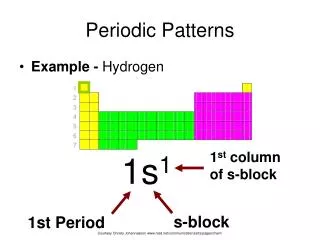
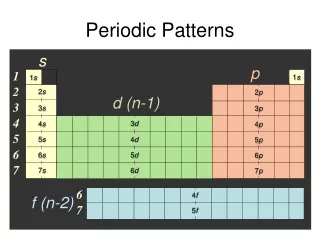
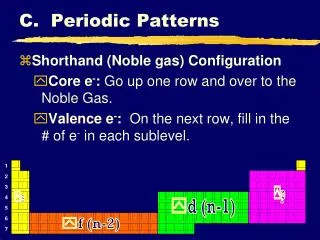
p s d (n-1) f (n-2) C. Periodic Patterns • Shorthand (Noble gas) Configuration • Core e-: Go up one row and over to the Noble Gas. • Valence e-: On the next row, fill in the # of e- in each sublevel.
C. Periodic Patterns • Example - Germanium [Ar] 4s2 3d10 4p2
Core Electrons Valence Electrons • Longhand Configuration S 16e- 2p6 2s2 1s2 3s2 3p4 • Shorthand Configuration S 16e-[Ne]3s2 3p4
D. Stability • Full energy level • Full sublevel (s, p, d, f) • Half-full sublevel
D. Stability • Electron Configuration Exceptions • Copper EXPECT: [Ar] 4s2 3d9 ACTUALLY: [Ar] 4s1 3d10 • Copper gains stability with a full d-sublevel.
D. Stability • Electron Configuration Exceptions • Chromium EXPECT: [Ar] 4s2 3d4 ACTUALLY: [Ar] 4s1 3d5 • Chromium gains stability with a half-full d-sublevel.
D. Stability • Ion Formation • Atoms gain or lose electrons to become more stable. • Isoelectronic with the Noble Gases. 3+ 1+ NA 2+ 1- 0 3- 2-
D. Stability • Ion Electron Configuration • Write the e- config for the closest Noble Gas • EX: Oxygen ion O2- Ne O2- 10e- [He] 2s2 2p6