The Millennial Context of Global Sea Level Rise: Are IPCC Predictions Underestimating Reality?
70 likes | 198 Vues
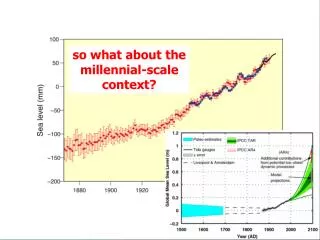
This analysis explores the historical trends in global sea level rise, highlighting that levels remained stable for thousands of years before accelerating in the late 19th century. During the satellite era, sea levels rose approximately 3 mm/year, with regions like the central U.S. Gulf Coast experiencing rises 4 to 5 times greater compared to the pre-industrial period. The future trajectory of sea levels poses uncertainty, significantly influenced by the stability of Greenland and West Antarctic ice sheets, demonstrating the urgent need to reassess climate predictions.


The Millennial Context of Global Sea Level Rise: Are IPCC Predictions Underestimating Reality?
E N D
Presentation Transcript
IPCC predictions too conservative???
Global sea level has remained close to stationary during the past few thousand years prior to the industrial revolution • A global acceleration of sea level started in the late 19th or early 20th century, reaching ~3 mm/yr during the satellite era (since 1993) • Along the central US Gulf Coast, sea level has risen 4 to 5 times faster in the 20th century compared to the pre-industrial millennium • Sea level will very likely continue to accelerate in the next century; yet by which amount remains uncertain • The future of the US Gulf Coast depends in large part on the stability of the Greenland and West Antarctic ice sheets