Speed and Velocity
This resource explains the fundamental concepts of speed and velocity, two essential aspects of motion. Speed is defined as a scalar quantity with no direction, indicating how fast an object is moving and measured as distance over time. Conversely, velocity is a vector quantity, combining both speed and direction, which reveals how far an object is from its starting point over a specified time. The differentiation between distance and displacement is crucial, highlighting the importance of reference points. Discover how these principles apply in everyday contexts.

Speed and Velocity
E N D
Presentation Transcript
A rate is: • Quantity/time • It tells us: • How fast something is moving • How much something changes in a given time • Motion is relative • Everything moves • Things at rest on earth move relative to the Sun and Stars • A vector is a quantity with both • Magnitude (size) • Direction • Scalar is • A quantity with Magnitude only
Position - Separation between an object and the reference point. • It is a vector (has size and direction) • A reference point must be chosen • Distance • Total distance traveled – no direction • Displacement -where you are compared to where you started. • It is a vector. • Equation: d = df - di
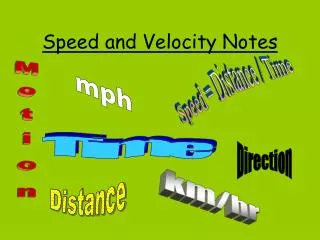
Speed measures • How fast something is moving • It is the rate at which distance is covered • It has no direction • It is measured in terms of Units of distance/Units of time • Average speed • Total distance/time or v = d/t • It is an average • It is the whole distance • It is not displacement • It does not indicate different speeds and variations
Velocity tell us: • How fast • It is speed in a given direction • It tells us how fast and in what direction • Constant velocity - Displacement/time • Equation: v = df – di /t