Download
1 / 5
50 likes | 172 Vues
“I Can” objectives are essential understandings crafted in student-friendly language that break down complex concepts into manageable steps. They help students identify where they struggle in the learning process. This guide outlines how to create effective “I Can” objectives based on standards, using a specific example related to finding the area and perimeter of 2-D figures. By formulating both a main objective and smaller, supportive statements, educators can provide clarity and foster student engagement in mathematics.

E N D
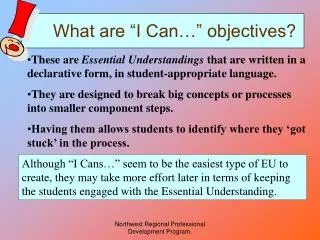
What are “I Can…” objectives? • These are Essential Understandings that are written in a declarative form, in student-appropriate language. • They are designed to break big concepts or processes into smaller component steps. • Having them allows students to identify where they ‘got stuck’ in the process. Although “I Cans…” seem to be the easiest type of EU to create, they may take more effort later in terms of keeping the students engaged with the Essential Understanding. Northwest Regional Professional Development Program.
How to make an I Can Objective… • First, select your standard: Measurement Math 3.6.3: Select, model, and apply formulas to find the perimeter, circumference, and area of plane figures. Northwest Regional Professional Development Program.
How to make an I Can Objective… Step #1: Write “I can…” in front of the standard: I can select, model, and apply formulas to find the perimeter, circumference, and area of plane figures. Step #2: Simplify into kid-friendly language I can find the area and perimeter of 2-D figures using more than one method Northwest Regional Professional Development Program.
Your Big “I Can…”: I can find the area & perimeter of 2-D figures using more than one method. • Step #3: Now…formulate smaller “I can…” statements that will serve as the steps for knowing how to do your BIG “I can…” statement. • I can explain the difference between area and perimeter of polygons. • I can find the area & perimeter of regular 2-D figures in at least 2 different ways. • I can locate the appropriate formula to use. • I can explain how the formula relates to the figure. • I can make number substitutions in a formula and accurately compute the answer. • I can make a good estimate of a reasonable answer for this type of problem. Northwest Regional Professional Development Program.
“I Can…” Objectives Activity Please do the following: • Use the NWRPDP “I Can” template. • Create one over-arching BIG “I can…” objective for a standard you’ll be teaching soon. • Brainstorm and create 5-6 smaller “I can…” statements. • Prepare to report out to your PLC. Northwest Regional Professional Development Program.