Download
1 / 16
270 likes | 496 Vues
Master the concept of countable and uncountable nouns with this comprehensive guide by Begonya Santiago. Learn the differences between these noun types through clear explanations and practical exercises featuring examples like "milk," "coffee," "burger," "cheese," and more. Discover how to use quantifiers like "a," "some," and "any" effectively in sentences related to various nouns. This resource is perfect for English learners looking to deepen their understanding and improve their language skills.

E N D
COUNTABLE AND UNCOUNTABLE NOUNS Explanation and exercises by Begonya Santiago
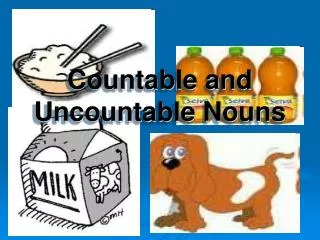
Are these nouns countable or uncountable? • Uncountable. • There is some milk.
coffee • Uncountable. • There is some coffee. • A cup of coffee or two cups of coffee.
Hamburger. • Countable. • A burger. • One or two three burgers • There are some burgers.
Cheese. • Uncountable. • There is some cheese. • A piece of cheese.
Icecream. • Countable. • There are three icecreams. • There are some icecreams.
Sausage. • Countable. • A sausage. • There is a sausage. • Two sausages. • There are some sausages. • There is a hot dog. • Two hot dogs.
Biscuit. • Countable. • A biscuit. • Two biscuits. • There is a biscuit. • There are some ginger biscuits. • There aren’t any chocolate biscuits.
Chair. • Countable. • A chair. • There is a chair. • There are some chairs in this class.
Sofa. • Countable. • A sofa. • Two sofas. • There is a sofa in my house. • There aren’t any sofas in this class.
Banana. • Countable. • There is a banana. • There are some bananas. • There are two bananas.
Strawberry. • Countable. • There is a strawberry. • Three strawberries. There are three strawberies. • There are some strawberries. • There isn’t any cream.
Lemon, orange and tomato. • All are countable. • A lemon, an orange a tomato. • Two or three lemons, oranges and tomatoes. • There are some lemons and some tomatoes and some oranges but there aren’t any carrots.
A, an, some and any. • We use Awith countable nouns: a pear, a peach, a tomato, a sofa. • We use AN when the words starts with a vowel: an orange, an umbrella. • We use SOME with countable and uncountable nouns ( without specifying the exact number)in affirmative sentences: some milk, some potatoes, some sugar, some books, some cds. • We use ANY with countable and uncountable nouns in negative and interrogative sentences: any coffee, any chairs, any furniture.
Read the following examples. • There are some tomatoes. • There are some melons. • There some cucumbers. • There are some oranges • There aren’t any onions. • There isn’t any milk in the greengrocer’s. • There isn’t any sugar in the greengrocer’s.
Make sentences about the picture using the following words: pan, fridge, table, kitchen cloth, spoon, milk, salad, window, oven, girl...