
SlideServe
Menu
Préférences
© SlideServe · v2026

Ostrich: Largest Living Bird of the African Grasslands

pattiv avatar
7 diapositives · 381 Views · Jan 03, 2020

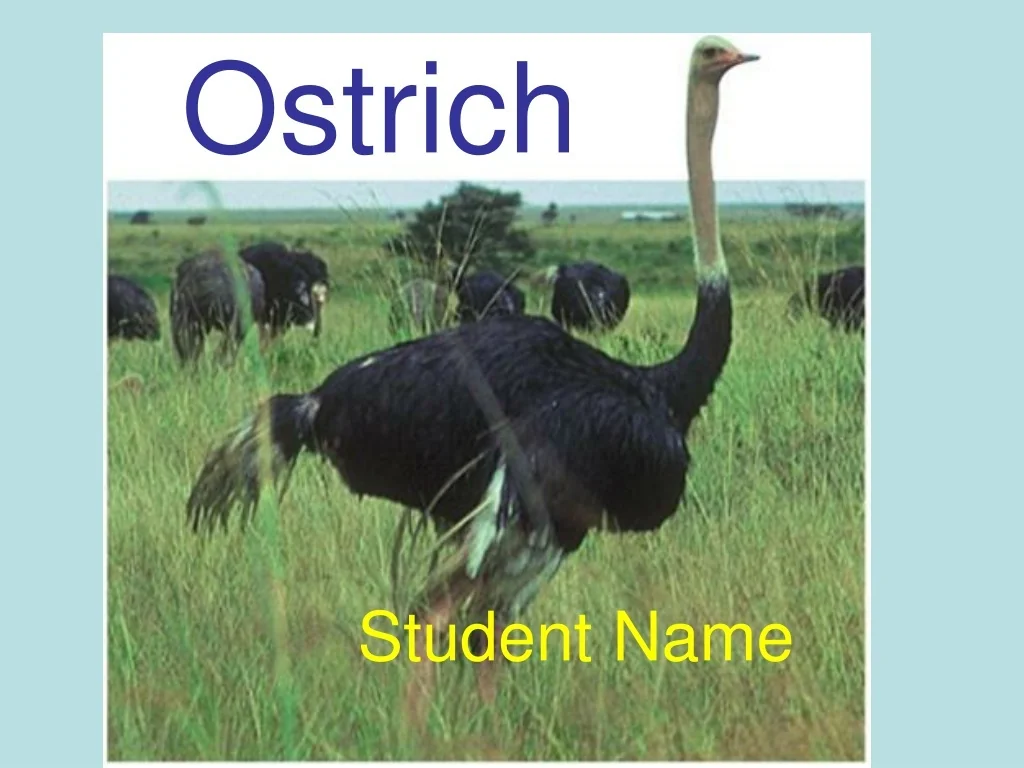
Ostriches are found in the dry grasslands and semi-desert areas of Africa. They live in groups but can be solitary. Ostriches have powerful legs for speed and can't fly. They employ unique defensive behaviors like stretching their necks. Males help with nesting and care for young. Interesting facts include their large size, long lifespan, and exceptional egg size. Dive into the world of ostriches with BBC Nature, Animal Diversity Web, and National Geographic resources.
Ostrich: Largest Living Bird of the African Grasslands - slide 1
01 / 7Ostrich: Largest Living Bird of the African Grasslands
1 / 17

Télécharger la présentation

Ostrich: Largest Living Bird of the African Grasslands
Une image / un lien ci-dessous est fourni (tel quel) pour télécharger la présentation

Politique de téléchargement : le contenu du site vous est fourni TEL QUEL pour votre information et votre usage personnel ; il ne peut être vendu, concédé sous licence ni partagé sur d’autres sites sans l’accord de son auteur.Le contenu vous est fourni TEL QUEL, pour votre information et votre usage personnel uniquement. Téléchargez la présentation en cliquant sur ce lien. Lors du téléchargement, si vous ne parvenez pas à télécharger une présentation, l’éditeur a peut-être supprimé le fichier de son serveur.Pendant le téléchargement, si vous ne parvenez pas à obtenir une présentation, le fichier a peut-être été supprimé par l’éditeur.

F I N

Plus de contenu associé

Transcription de la présentation
  1. Ostrich Student Name

  2. Habitat Ostriches are found in the dry grasslands and semi-desert areas of eastern and southern Africa. They tend to live in mixed groups of 5 - 50 individuals but sometimes they live alone.

  3. Physical Adaptations The wing bones of ostriches are the same as other birds, but ostriches cannot fly. Their need for flight diminished since their long, powerful legs enable them to outrun most predators at speeds up to 43 mph. If cornered, a single kick with their powerful legs can alsobe fatal to its enemies.

  4. Behavioral Adaptations Ostriches stretch out their neck and lay their head on the ground to keep from being seen, but they do not bury their head in the sand! The males build the nests, help incubate the eggs, and care for the young birds. If the females had to stay on the nests all the time, they would not be able to look for the large amount of food it requires to produce more eggs.

  5. Interesting Facts • The ostrich is the largest living bird. • It can grow up to 9 feet tall and 345 pounds. • Some ostriches can live to be 70 years old. • One ostrich egg equals up to 24 chicken eggs. • The ostrich has the biggest eyeball of any bird-they are 2 inches across. • A female ostrich can recognize her own • eggs, even when mixed in with • the eggs of other females.

  6. Resources "BBC Nature - Ostrich videos, news and facts." BBC - Homepage. N.p., n.d. Web. 6 Dec. 2011. <http://www.bbc.co.uk/nature/life/Ostrich>. Donegan, Keenan. "ADW: Struthio camelus: Information." Animal Diversity Web. N.p., n.d. Web. 6 Dec. 2011. <http://animaldiversity.ummz.umich.edu/site/accounts/information/Struthio_camelus.html>. “Ostriches, Ostrich Pictures, Ostrich Facts - National Geographic." Animals - Animal Pictures - Wild Animal Facts - Nat Geo Wild - National Geographic. N.p., n.d. Web. 6 Dec. 2011. <http://animals.nationalgeographic.com/animals/birds/ostrich/?source=A-to-Z>.