Exploring Renaissance Art and Key Concepts**
The Renaissance marked a profound transformation in art, culture, and ideas. This review delves into essential concepts such as humanism, secularism, realism, and patronage, alongside the influence of figures like the Medici. It highlights the evolution from medieval art, examining elements like hieratic scale and linear perspective. By analyzing notable artworks—including the Madonna and Child series—we uncover how these pieces reflect the societal ideals of their time. Explore how art changes perception, and how economic shifts fueled this vibrant period of creativity and reform.

Exploring Renaissance Art and Key Concepts**
E N D
Presentation Transcript
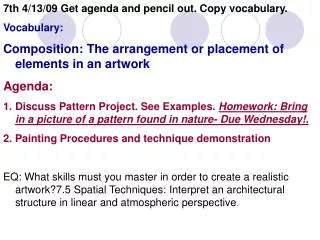
Copy Vocabulary • Reform - the improvement of what is wrong, corrupt, or unsatisfactory • Doctrine – policies or laws taught and advocated • Vernacular – everyday language people speak • Indulgence – pardon for a sin which releases someone from punishment • Nepotism – showing favoritism toward friends and family
Renaissance Review • What does “Renaissance” mean • Name two causes of the Renaissance • What is secularism? • What is humanism? • What is realism? • What is a patron? • Who were the Medici? • How did economies change during the Renaissance?
Essential Question • How does artwork change and how does it reflect the ideas of the Renaissance?
Renaissance Concepts/Ideas • Humanism • Secularism • Realism
Art Terms • Hieratic Scale – when artists make saints or members of the family of God larger than ordinary people • More important = larger • Linear Perspective – gives the illusion of depth and distance in artwork
Let’s have a look at some Medieval art (Middle Ages) • You should answer question 1 after viewing the artwork.
Medieval Art • How would you describe the art? • How do the figures look – are they realistic? • What kind of colors are used?
You tell me whether the paintings show linear perspective, hieratic style, or realism.