Understanding Collision Detection and Handling in Physics Simulations
This guide explores collision detection and handling in physics simulations, focusing on particle-environment interaction rather than direct particle-particle collisions. It covers methods to test for collisions with surfaces, including overshooting and penetration checks. The concepts of normal and tangential velocity, as well as the coefficient of restitution, are discussed to demonstrate changes in momentum and velocity upon collisions. Implicit equations of surfaces are highlighted as a straightforward method for detecting collisions, providing insights into handling complex surface definitions.

Understanding Collision Detection and Handling in Physics Simulations
E N D
Presentation Transcript
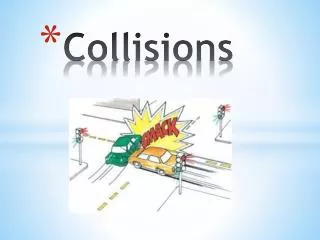
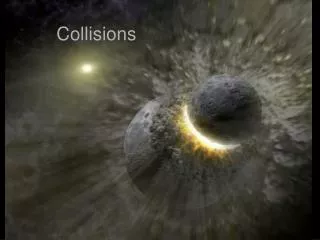
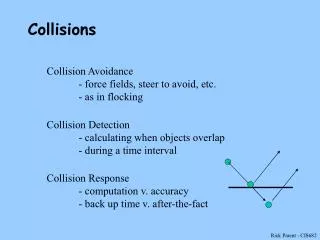
Collisions • Usually don’t test particle-particle collision • Test collision with environment, e.g. ground • Note: step overshoots collision • Test for penetration • back up or fixup
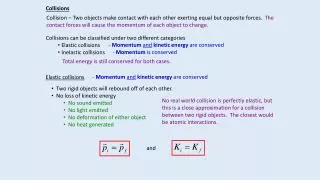
Handling collisions v N • tangential velocity vbunchanged • normal velocity vnreflects: • coefficient of restitution • change of velocity = -(1+є)v • change of momentum Impulse = -m(1+є)v • Remember mirror reflection? Can be seen as photon particles
Detecting collisions • Easy with implicit equations of surfaces • H(x,y,z)=0 at surface • H(x,y,z)<0 inside surface • So just compute H and you know that you’re inside if it’s negative • More complex with other surface definitions