
ITCS 6162 Project Action Rules Implementation
E N D
Presentation Transcript
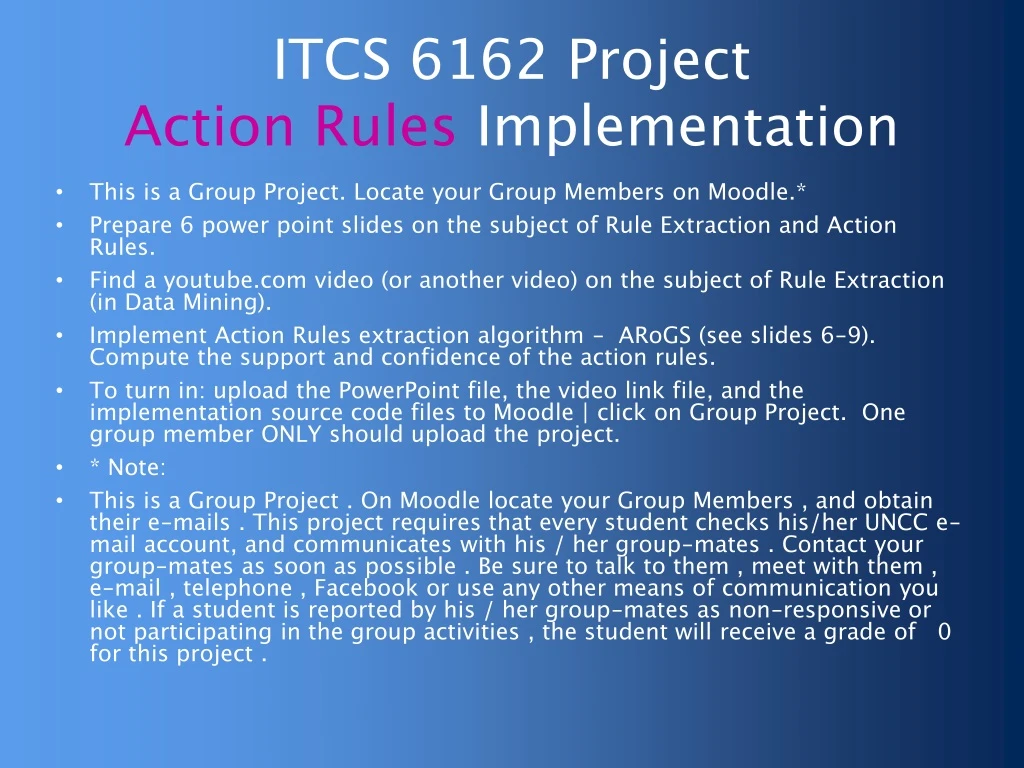
ITCS 6162 ProjectAction Rules Implementation • This is a Group Project. Locate your Group Members on Moodle.* • Prepare 6 power point slides on the subject of Rule Extraction and Action Rules. • Find a youtube.com video (or another video) on the subject of Rule Extraction (in Data Mining). • Implement Action Rules extraction algorithm - ARoGS (see slides 6-9). Compute the support and confidence of the action rules. • To turn in: upload the PowerPoint file, the video link file, and the implementation source code files to Moodle | click on Group Project. One group member ONLY should upload the project. • * Note: • This is a Group Project . On Moodle locate your Group Members , and obtain their e-mails . This project requires that every student checks his/her UNCC e-mail account, and communicates with his / her group-mates . Contact your group-mates as soon as possible . Be sure to talk to them , meet with them , e-mail , telephone , Facebook or use any other means of communication you like . If a student is reported by his / her group-mates as non-responsive or not participating in the group activities , the student will receive a grade of 0 for this project .
ITCS 6162 ProjectAction Rules Implementation • For input to the program , choose one dataset from : • http://archive.ics.uci.edu/ml/datasets.html • to download use http://mlearn.ics.uci.edu/MLSummary.html • Input should be: 2 flat text files (as downloaded from the link) . 1st file .data - program should handle comma “ , “ delimited and tab “ “ delimited data formats . 2nd file .names - containing attribute names each on a new line . • Test program with at least 3 different datasets from this link (should work with BOTH categorical and numerical attribute types (all attribute types)) • We will test your program with a random data sample from the link above . Program should not crash , hang (freeze) , or take more than 3 minutes (180 seconds) to complete . Keep implementation SIMPLE . • Program should NOT generate DUPLICATE rules . Add a module to the program to check for duplicates , and remove them , before producing the output . • Program should produce an Output File (flat text), which contains all the output Action Rules extracted, including support and confidence for each rule . • Interface: should allow to OPEN a dataset file (flat text file) | allow user to specify support and confidence tresholds | display all attribute names and allow user to specify stable and flexible attributes | allow user to specify DECISION attribute, display all values of decision attribute and allow user to specify desired class – for example: decision D change from d1 -> d2 | display all Action Rules produced
atomic action terms action rule ARED – Object Based Action Rule Discovery (a, a1 →a1) (a, a2 → a2) (b, b1 → b1) (b, b2 → b2) ……….. (d, d1 → d1) (d, d2 → d2) (a, a2) * (b, b1) Y = {x2, x4} (d, d1) Z = {x1,x2,x3,x4,x5,x7} Decision System S r=[(a, a2→ a2)*(b, b1→ b1)] → (d, d1→ d1) (w, w) ∈ (Y, Y ) → (w,w) ∈ (Z, Z) Support: Confidence: sup(r) = 2 conf(r) = 2/2 = 1
atomic action terms rule (a, a1 →a1) (a, a1 → a2) (b, b1 → b2) (b, b2 → b2) ……….. (d, d1 → d1) (d, d2 → d2) Decision System S r=[(a, a2→ a1)*(b, b1→ b1)] → (d, d1→ d2) (Y1, Y 2) (Z1, Z2) sup(r) = 2 conf(r) = 1/2 Y1 = {x2, x4} Z1 = {x1,x2,x3,x4,x5,x7} Y2 = {x1, x6} Z2 = { x6}
atomic terms rule (a, a1 →a1) (a, a1 → a2) (b, b1 → b2) (b, b2 → b2) ……….. (d, d1 → d1) (d, d2 → d2) Decision System S r=[(a, a2→ a1)*(b, b1→ b1)] → (d, d1→ d2) (Y1, Y 2) (Z1, Z2) sup(r) = 1 conf(r) = 1/2 Y1 = {x2, x4} Z1 = {x1,x2,x3,x4,x5,x7} Y2 = {x1, x6} Z2 = { x6}
ARoGS - Action Rules Discovery Decision table S = (U, AFl∪ ASt∪ {d}). Assumption: {a1,a2,...,ap} ⊆ ASt, {b1,b2,...,bq} ⊆AFl, ai,1∈Dom(ai), bi,1∈Dom(bi). Rule: r = [a1,1∧a2,1∧... ∧ap,1] ∧[b1,1∧ b2,1∧... ∧ bq,1] →d1 stable part flexible part Action rule schema r[d2 → d1] associated with r and re-classification task (d, d2→d1): [a1,1∧a2,1∧... ∧ap,1] ∧ [(b1, → b1,1 )∧ (b2, → b2,1)∧... ∧ (bq, → bq,1)] →(d, d2→d1)
ARoGS - Action Rules Discovery Decision System S a, b, c – stable e, f, g - flexible Goal: reclassify objects in S from class d2 to d1.
Step 1: extract all rules , which imply → d1 (have d1 on the right side) by using LERS algorithm . For each rule r : { Step 2. generate r[d2 → d1] (action rule schema) by: r1 = [b1∧c1∧f2∧g1] →d1 r1[d2 →d1] = [b1∧c1∧ (f, →f2) ∧(g, →g1)] → (d, d2→d1) b1∧c1 – stable f2∧g1 – flexible (f, →f2) means change f from anything to f2 Step 3. compute set of objects supporting the schema r[d2 → d1] U[r1,d2] = Sup(r1[d2 →d1]) = {x3, x6, x8} Step 4. take the header (stable attributes i.e. b1∧c1) from r[d2 → d1] and combine with all remaining attribute values . Mark the subsets of U[r1,d2] [b1∧c1∧a1]∗ = {x1} ⊄U[r1,d2] [b1 ∧c1∧a2]∗ = {x6, x8} ⊆ U[r1,d2] marked [b1∧c1∧a3]∗ = {x3} ⊆U[r1,d2] marked [b1∧ c1∧f3]∗= {x6} ⊆U[r1,d2] marked [b1∧c1∧g3]∗ = {x3,x8} ⊆U[r1,d2] marked
Step 5 From marked generate action rules by using r1[d2 → d1] Action Rules: [b1 ∧ c1 ∧ a2 ∧ (f, → f2) ∧ (g, → g1)] → (d, d2 → d1), [b1 ∧ c1 ∧ a3 ∧ (f, → f2) ∧ (g, → g1)] → (d, d2 → d1), [b1 ∧ c1 ∧ (f, f3 → f2) ∧ (g, → g1)] → (d, d2 → d1), [b1 ∧ c1 ∧ (f, → f2) ∧ (g, g3 → g1)] → (d, d2 → d1) }