
Enhancing Reading Fluency: Strategies and Assessments for Educators
E N D
Presentation Transcript
Fluency Chapter 10
Reflections on Fluency • Have you ever been to a book reading where the author read her material very slowly and monotonously? • Were you able to follow the narrative? • How were you able to prevent yourself from daydreaming or dozing off? • How can you make sure your students don’t have similar problems when reading aloud?
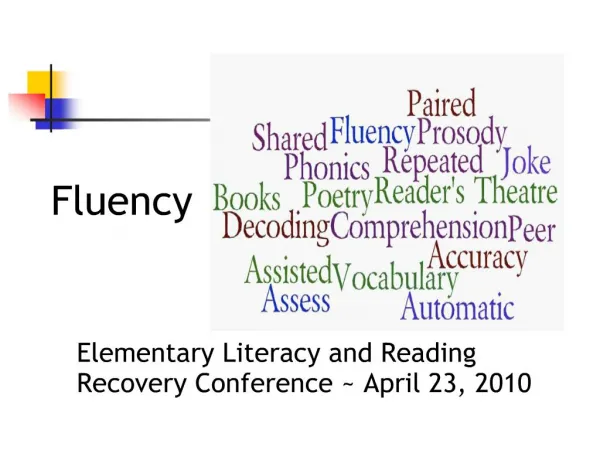
Introduction to Fluency • Fluency is the ability to read with automatic word recognition, expression, and meaning. • What does fluency entail? Fluent readers: • Read at a good pace • Attend to the punctuation in sentences • Recognize words automatically • Quickly decode unknown words • Slow down when needed • Use expression when reading aloud
Components of Fluency • Rate • Automaticity/accuracy: • Recognizing common words • Associating letter/letter combinations with their sounds • Recognizing chunks/syllables within words • Recognizing the meanings of words • Prosody/phrasing • Parsing phrases • Expressive reading • Punctuation • Comprehension
Traits of Fluent Readers • Use knowledge of language to keep reading • Use an appropriate reading rate • Slow down to solve problems • Have automatic word recognition and word analysis skills • Use intonation to convey meaning • Adhere to punctuation cues • Use knowledge of story structure and expository text to keep reading • Reproduce the natural phrasing of the text
How Punctuation Can Change Meaning • A panda eats, shoots, and leaves. • The panda goes into a restaurant, orders a meal, eats it, shoots a fellow diner, and then leaves. • A panda eats shoots and leaves. • The panda eats the shoots and leaves of a bamboo plant.
Fluency Instruction for English Learners • The teacher reads a short passage (on the student’s instructional level) to the English learner. • The teacher and learner read the passage together. • The learner reads the passage so the teacher can assess progress. • The teacher times the learner’s reading, to record reading rate. • The learner practices to increase rate and improve intonation. • The learner listens to a recording of his/her reading to self-assess.
Assessment of Fluency:Informal • Checklists • Running records • Miscue analysis • Retrospectivemiscue analysis • Rubrics • Informal commercial assessments
Assessment of Fluency: Formal • Calculate rate and/or accuracy; for example: • Stanford Diagnostic Reading Test • Gray Oral Reading Tests • Gilmore Oral Reading Test • Durrell Analysis of Reading Difficulty • Diagnostic Reading Scales, Revised • Woodcock Reading Mastery Test • Instruments do not allow teachers to assess other components of fluency
Rubric for Reading ComprehensionBased on Illinois’s Standard 1.B.1d for EarlyElementary School English/Language Arts
Suggested Fluency Instruction for English Learners • Teacher reads a short passage (on the correct reading level) to the student. • Teacher and learner read the passage together. • Learner reads the passage so the teacher can assess progress. • Teacher times learner’s reading, to record reading rate. • Learner practices to increase rate and intonation. • Learner listens to a recording to self-assess.
Intervention StrategiesFocusing on Fluency • For tutoring settings: • Echo reading • Preview-pause-prompt-praise (PPPP) strategy • Oral recitation lesson (ORL) • Carbo Recorded-Book Method • Record, Check, Chart • Flash cards (continued)
More Intervention Strategies • Fluency development lesson (FDL) • Speech reading • Telling jokes • Supported-reading strategy • Dyad reading • Repeated readings • Poetry party • Readers theater • Choral reading • Rhythm walks • Strategies to use with small groups:
Fluency and Technology • Audiobooks—to follow along, or read along with the narrator • Reading Assistant Expanded Edition—speech recognition software • Read-along radio dramas • Websites with free scripts for readers theater
Related Video Presentation • You can see a video presentation on direct instruction in fluency with echo reading (see echo reading in action; this is related to the discussion on pages 270–271 of the chapter).