Comprehensive Guide to Straight Lines, Differentiation, and Quadratic Equations
This resource offers a detailed overview of key concepts in mathematics, focusing on straight lines and their gradients, simultaneous equations, rationalizing surds, and various differentiation techniques. It explains how to derive tangent and normal gradients, find stationary points, apply the Binomial Expansion, and utilize the Factor and Remainder Theorem. Additionally, it covers solving quadratic inequalities, completing the square, and transforming graphs, ensuring a solid understanding of these essential topics for students and math enthusiasts alike.

Comprehensive Guide to Straight Lines, Differentiation, and Quadratic Equations
E N D
Presentation Transcript
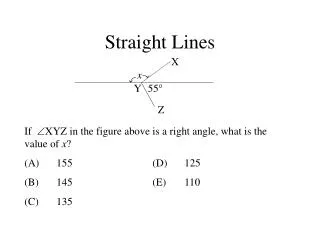
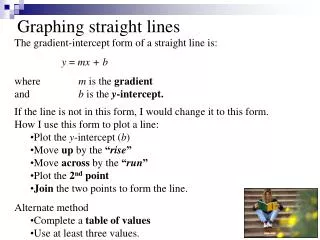
Straight Lines • Draw a diagram • Y – y coordinate = gradient ( x – x coordinate) • Gradient of Perpendicular lines x to -1 • Intersect lines = solve the 2 lines as simultaneous equations
Surds • Rationalise by x top and bottom by √11 – 2 • Treat like eyebrows and smiley face 25x2 • X top and bottom by √2
Differentiation I Move power up to top as a negative Square root is power 1/2
Differentiation II Get dy/dx This gives tangent gradient Turn upside down and change sign for normal gradient Equation of line y – y coord = gradient (x – x coord)
Differentiation III Get dy/dx Solve dy/dx=0 to get stationary points Use x values in y= formula to get y values Use d2y/dx2 to decide max or min
Binomial Expansion Use formula booklet for ( a + b ) n if you know n Use to find n Watch out for powers of eg 3x So 6 x (3X)2 = 6 x 9X2 = 54 X2
Factor and Remainder Theorem Use x = -3, put equal to -39 If x = -3 gives zero, x + 3 would be a factor Get one factor, then use long division
Roots of a quadratic Write down a, b and c then use the above facts Solve inequalities like quadratic equations
Completing the square Half and square