Download
1 / 3
30 likes | 219 Vues
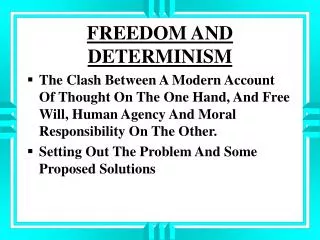
This exploration delves into the theories of freedom and determinism, examining how human actions are influenced by unconscious desires, environmental factors, and heredity, as proposed by Hard Determinism. It contrasts these views with Libertarianism, which posits that free choices define our identity. The text raises objections to determinism, questioning the possibility of changing attitudes and understanding behavior through reasons instead of mere causes. It further discusses the implications of freedom on morality and self-consciousness from the perspectives of existentialism and Kantian philosophy.

E N D
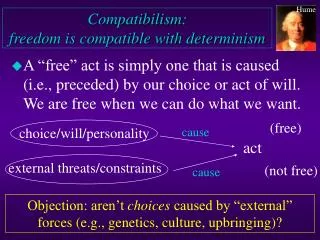
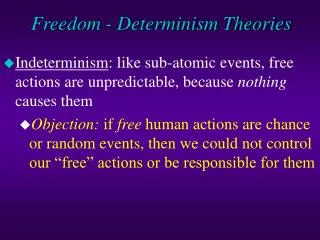
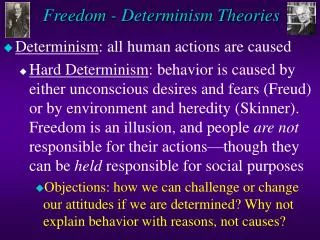
Freedom - Determinism Theories • Determinism: all human actions are caused • Hard Determinism: behavior is caused by either unconscious desires and fears (Freud) or by environment and heredity (Skinner). Freedom is an illusion, and people are not responsible for their actions—though they can be held responsible for social purposes • Objections: how we can challenge or change our attitudes if we are determined? Why not explain behavior with reasons, not causes?
Freedom - Determinism Theories • Libertarianism: our free choices define our selves: this is what we experience, and is what our theory should explain (Sartre) • Objection: how can “we” be both cause & effect? • Freedom as an Assumption: Morality requires that we think of ourselves as free. As objects in the world, we are determined; but as conscious, choosing beings, we are free (Kant)
Freedom - Determinism Theories • Existentialism: freedom & self-consciousness consist in our ability to conceive that which is not—and that could not be caused by what is • The proper way to describe human actions is in terms of reasons, not causes Objection: Wanting to believe in freedom does not make it true; besides, even that belief itself is determined