Optimizing Total Ownership Cost (TOC) in Acquisition Through CAMELOT Framework
The CAMELOT framework focuses on enhancing decision-making in acquisition processes by optimizing Total Ownership Cost (TOC). Early involvement in design and logistics significantly impacts TOC, but this information is often overlooked during source selection. The framework emphasizes the importance of sharing data between contractors and the government, utilizing analytical tools, and implementing performance incentives to promote competition. CAMELOT aims to enhance TOC management and accountability, ensuring effective contractor performance and reliable estimations throughout the acquisition lifecycle.

Optimizing Total Ownership Cost (TOC) in Acquisition Through CAMELOT Framework
E N D
Presentation Transcript
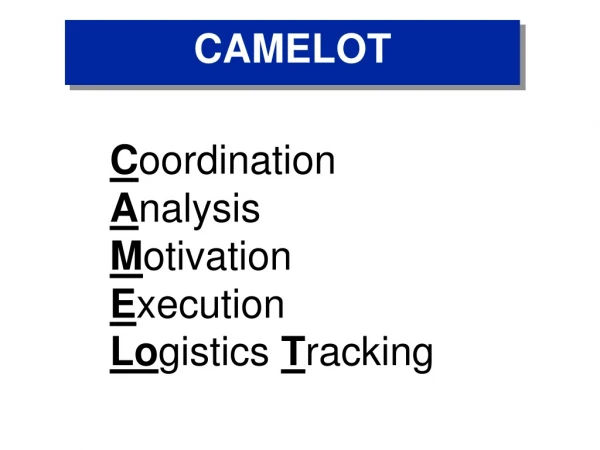
CAMELOT Coordination Analysis Motivation Execution Logistics Tracking
Why CAMELOT? • Most of the System TOC is not Considered During a Source Selection • TOC is Driven by Early-on Design & Logistics Decisions • Necessary Information to Make Best Value TOC Decisions is not Normally Obtained • TOC must be Managed to be Reduced
Coordination • Transition the Requirements & Key Performance Parameters from the Customer/User Representatives • Discuss TOC or Ao Modeling with Industry • Internally Discuss Contract Requirements & Government Controlled Inputs to Properly Evaluate TOC or Ao
COORDINATION TOOLS COMMERCE BUSINESS DAILY BUSINESS OPPORTUNITY PAGES DRAFT RFP APBI ASOAR SOO ICT/IPT
Analysis • Utilization of the Right Analytical Tools Throughout the Acquisition Process • Contractors & Government will be Utilizing the Same Tools to Optimize to Availability or Determine the TOC Impact of Proposed Actions PROPOSE IMPROVE MEASURE
D D CAMELOT Analysis ProcessTOC Modeling Portion Contractor Inputs Proposed Negotiated Improved Actual Revised Baseline Evaluated Baseline Proposed Realized Expected Expected Actual Expected Government Inputs Proposed Savings Realized Savings/Costs
ANALYTICAL TOOLS ACE-IT SESAME COMPASS CWARM LCET SW COST MODELS QUANTITY DISCOUNT EOQ TAILORED EXCEL SPREADSHEETS
Motivation • Contractor’s TOC Evaluated in Source Selection to Stimulate TOC Competition • TOC Management Techniques Proposed & Evaluated in Source Selection • Establishing a Shared Data Environment • Managing TOC Reduction • Contractors Share in the Benefits Associated with their TOC Reduction Efforts by Incentives
MOTIVATION TOOLS PERFORMANCE INCENTIVES SHARED SAVINGS COMPETITION AWARD FEES TOC IN SOURCE SELECTION VALUE ENGINEERING PROGRAM
Execution • TOC Baseline Factors are Determined Through Negotiations Prior to Award • Verification Procedures are Developed with Industry • Remedies to the Government are Clear & Corrective in Nature • Contractor Performance Fed into Performance History Database for Future PRAG
EXECUTION TOOLS FIXED PRICE CONTRACTS LONG TERM WARRANTIES CONTRACT BASELINES PRAG INPUT TOC REDUCTION MANAGEMENT PROGRAM
LOgisticsTracking • Contractor Maintains Data in Their Own Format Covering All TOC Factors Within Their Control & Responsibility • Update of TOC Estimates Based on Field Returns or Proposed Improvements • Shared Data Environment Between Government & Contractor
LOGISTICS TRACKINGTOOLS CONTRACTOR MGMT INFO PRACTICES SHARED DATA ENVIRONMENT GOVERNMENT DATABASES VIRTUAL TRACKING SYSTEM LOGS FRACAS
CAMELOT Changes to Current Acquisition Practices • Analyze System Reliability and Availability Requirements within Government • Use Govt Ao Driven LCC Models for Best Value Decisions & Encourage Industry to Use Them • Use TOC or Ao as an Evaluation Factor in Source Selection • Provide Incentives to Industry for TOC Reduction • Hold Industry Accountable for Delivering What It Promises • Establish a Shared Data Environment