Download
1 / 27
270 likes | 385 Vues
Join the fun with our 7th-grade science Jeopardy, hosted by the HMS science teachers! This engaging quiz covers critical topics including speed, density, watersheds, and the solar system. Compete in various categories with questions ranging from simple definitions to complex interactions in nature. Enjoy the challenge of determining average speeds, understanding densities, and exploring scientific concepts like adaptation and energy. Perfect for reinforcing classroom learning while promoting teamwork and enthusiasm for science!

E N D
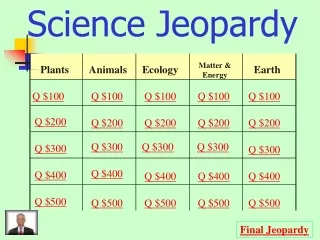
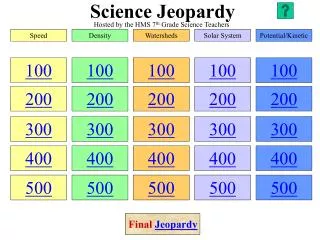
Science Jeopardy Hosted by the HMS 7th Grade Science Teachers Speed Density Watersheds Solar System Potential/Kinetic 100 100 100 100 100 200 200 200 200 200 300 300 300 300 300 400 400 400 400 400 500 500 500 500 500 Final Jeopardy
ANSWER:The average speed of a car that travels 75 meters in 15 seconds QUESTION: What is 5 m/s A-100
ANSWER: This is the formula for calculating speed QUESTION: What is D/T or distance over time? A-200
ANSWER: This is the overall speed at which an object moves QUESTION: What is Average Speed? A-300
ANSWER: The speed of a sailboat that is traveling 100 meters in 120 seconds QUESTION: .83 m/s A-400
ANSWER: Tom rolled his ball 12m in 11 seconds. Jane rolled her ball 15m in 13 seconds. Who had the fastest average speed QUESTION: Who is Jane at 1.15 m/s (Tom was 1.09 m/s) A-500
ANSWER: The units for Density of a liquid QUESTION: What is grams per milliliter or g/mL B-100
ANSWER: The density of water at which we compare the density of other objects too. QUESTION: 1 g/mL B-200
ANSWER: An object that is greater than 1g/mL will QUESTION: What is sink B-300
ANSWER: The density of a piece of wood that has a mass of 120g and a volume of 7mL QUESTION: What is 17.14g/mL B-400
ANSWER: The volume of an object that is 220g and has a density of 55g/mL QUESTION: What is 4mL B-500
ANSWER: Water that enters or seeps into the soil QUESTION: What is Groundwater? C-100
ANSWER: QUESTION: C-200
ANSWER: A slowed physiological state of an organism to survive long periods of cold temperatures or reduced food supply. QUESTION: What is Hibernation? C-300
ANSWER: The main adaptation developed by the Galapagos Finch which happened through Natural Selection. QUESTION: What is the beak size? C-400
ANSWER: A process by which an organism or population becomes better suited to its habitat QUESTION: What is Adaptation? C-500
ANSWER: Astronauts must exercise in space to? QUESTION: What is to prevent their bones and muscles from becoming weak D-100
ANSWER: Earth’s atmosphere is mostly made of this gas QUESTION: What is Nitrogen D-200
ANSWER: This keeps Earth’s temperature stable QUESTION: What is the atmosphere D-300
ANSWER: This protects the Earth from harmful particles that come from the sun QUESTION: What is Earth’s Magnetic Field D-400
ANSWER: This protects the Earth from harmful Ultraviolet rays QUESTION: What is the Ozone Layer? D-500
ANSWER: Energy of objects in motion QUESTION: What is Kinetic energy E-100
ANSWER: These make Work easier QUESTION: What isSimple Machines E-200
ANSWER: Recessive traits are able to be visible if… QUESTION: A recessive trait is received from both parents for a single trait. Ex: ff or bb E-300
ANSWER: A characteristic of an organism. QUESTION: What is a Trait E-400
ANSWER: The genetic traits of an organism are determined by… QUESTION: inherited genes from both the mother and father E-500
ANSWER: Why do most birds have an adaptation of Hollow Bones? QUESTION: (Answers may vary) To help them be lighter weight so as to have better flight. FINAL JEOPARDY