Understanding Direct and Indirect Objects in English Grammar
This comprehensive guide explains the concepts of direct and indirect objects in English grammar. A direct object is a noun or pronoun that receives the action of a verb, and can be identified by asking "Whom?" or "What?" about the action. An indirect object, on the other hand, tells who or what the action is for. It is crucial to note that if an indirect object is present, a direct object must also exist, but a direct object can stand alone. This resource provides clear examples and distinguishes between transitive and intransitive verbs.


Understanding Direct and Indirect Objects in English Grammar
E N D
Presentation Transcript
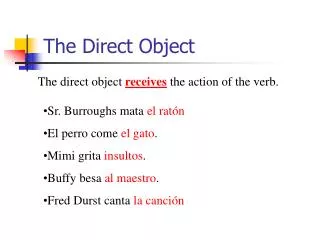
The direct Object
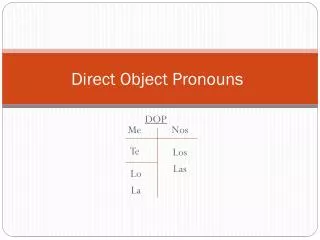
Direct Object • A noun or a pronoun. • Follows an action verb. • Receives the action of a verb. A direct object can be found by asking Whom? or What? about an action verb.
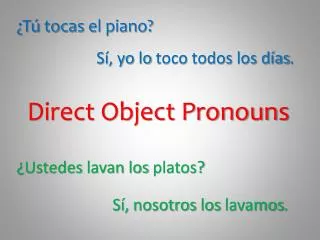
A direct object can be found by asking Whom? or What? about an action verb. Direct Object subject action verb The message reached the lawyer. The message reached WHOM?
A direct object can be found by asking Whom? or What? about an action verb. subject Direct Object action verb His landlord is raising the rent. Is raising WHAT?
A direct object can be found by asking Whom? or What? about an action verb. action verb subject DO Marty and Carol served pie and ice cream for dessert. DO Marty and Carol served WHAT?
A direct object is never an adverb or the object of a preposition. D.O. Joanne walked her dog. adverb Joanne walked briskly. Prepositional phrase Joanne walked to the store.
The Indirect Object
Indirect Object • A noun or a pronoun. • Tells to whom or to what or for whom or for what the action of the verb is done. subj. action verb direct obj. Andy brought a flower. subj. action verb indirect obj direct obj. Andy brought me a flower.
Indirect Object • A noun or a pronoun. • Tells to whom or to what or for whom or for what the action of the verb is done. subject action verb indirect object direct object Sarah showed the class her new glasses. Sarah showed her new glasses to whom? Jeff gave Caroline a chess set. Jeff gave a chess set to whom?
Please Note… If there is an indirect object, there must be a direct object. However, you can have a direct object without an indirect object.
**ONLY ACTION VERBS HAVE INDIRECT OBJECTS and DIRECT OBJECTS** Linking verbs do NOT have indirect objects or direct objects Linking verb: Zachary was a silly boy. Action verb: Zachary saw a silly boy. d. o.
Transitive Verb An action verb with a Direct Object Intransitive Verb An action verb with NO direct object or a linking verb (linking verbs are ALWAYS intransitive verbs)