Weight
This article explores key concepts in physics, including weight, mass, volume, and density. Weight measures the force of gravity on an object and varies between Earth and the Moon. Mass is a constant measurement of matter, remaining unchanged regardless of gravitational forces. Volume quantifies the space matter occupies, with common units including liters and cubic centimeters. Additionally, the article includes a density problem involving a block of wood, illustrating how to calculate density using mass and volume.

Weight
E N D
Presentation Transcript
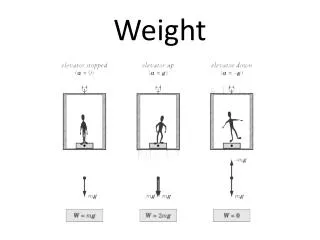
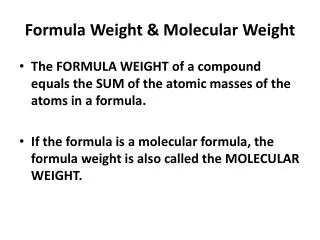
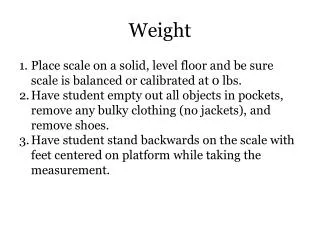
Weight A measure of the force of gravity on you. On the moon, you would weigh only about one-sixth of your weight on Earth.
Mass The measurement of the amount of matter in the object. Mass never changes, even if the force of gravity on the object changes.
Volume The amount of space that matter takes up. Common volume units: liter (L), milliliter (mL), cubic centimeter (cm3) Volume = Length x Width x Height
Density The amount of matter in a given space.
Sample Density Problem A small block of wood floats on water. It has a mass of 200 g and a volume of 250 cm3. What is the density of the wood?