Download
1 / 32
330 likes | 479 Vues
This article explores advanced clustering algorithms, focusing on Kernel K-Means and Spectral Clustering. Kernel K-Means applies the kernel trick to handle complex, non-linear clusters by mapping data to a higher-dimensional feature space. The discussion includes the limitations of Kernel K-Means, such as memory requirements and computational intensity. On the other hand, Spectral Clustering utilizes graph theory and eigenvector decomposition to identify clusters within data. Different forms of affinity matrices and their applications are also discussed, including examples from social networks and image segmentation.

E N D
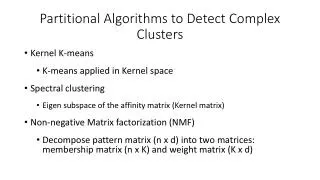
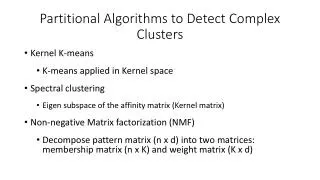
Partitional Algorithms to Detect Complex Clusters • Kernel K-means • K-means applied in Kernel space • Spectral clustering • Eigen subspace of the affinity matrix (Kernel matrix) • Non-negative Matrix factorization (NMF) • Decompose pattern matrix (n x d) into two matrices: membership matrix (n x K) and weight matrix (K x d)
Kernel K-Means RadhaChitta April 16, 2013
When does K-means work? • K-means works perfectly when clusters are“linearly separable” • Clusters are compact and well separated
When does K-means not work? When clusters are “not-linearly separable” Data contains arbitrarily shaped clusters of different densities
The Kernel Trick Revisited • Map points to feature space using basis function • Replace dot product .with kernel entry • Mercer’s condition: To expand Kernel function K(x,y) into a dot product, i.e. K(x,y)=(x)(y), K(x, y) has to be positive semi-definite function, i.e., for any function f(x) whose is finite, the following inequality holds
Kernel k-means Minimize sum of squared error: Kernel k-means: k-means: Replace with
Kernel k-means • Cluster centers: • Substitute for centers:
Kernel k-means • Use kernel trick: • Optimization problem: • K is the n x n kernel matrix, U is the optimal normalized cluster membership matrix
Example Data with circular clusters k-means
Example Kernel k-means
k-means Vs. Kernel k-means k-means Kernel k-means
Performance of Kernel K-means Evaluation of the performance of clustering algorithms in kernel-induced feature space, Pattern Recognition, 2005
Limitations of Kernel K-means • More complex than k-means • Need to compute and store n x n kernel matrix • What is the largest n that can be handled? • Intel Xeon E7-8837 Processor (Q2’11), Oct-core, 2.8GHz, 4TB max memory • < 1 million points with “single” precision numbers • May take several days to compute the kernel matrix alone • Use distributed and approximate versions of kernel k-means to handle large datasets
Spectral Clustering SerhatBucak April 16, 2013
Motivation http://charlesmartin14.wordpress.com/2012/10/09/spectral-clustering/
Graph Notation Hein & Luxburg
Clustering using graph cuts • Clustering: within-similarity high, between similarity low minimize • Balanced Cuts: • Mincut can be efficiently solved • RatioCut and Ncut are NP-hard • Spectral Clustering: relaxation of RatioCut and Ncut
Framework data Solve the eigenvalue problem: Lv=λv Create an Affinity Matrix A Construct the Graph Laplacian, L, of A Construct a projection matrix P using these k eigenvectors Pick k eigenvectors that correspond to smallestk eigenvalues Perform clustering (e.g., k-means) in the new space Project the data: PTLP
Affinity (Similarity matrix) Some examples • The ε-neighborhood graph: Connect all points whose pairwise distances are smaller than ε • K-nearest neighbor graph: connect vertex vm to vn if vmis one of thek-nearest neighbors of vn. • The fully connected graph: Connect all points with each other with positive (and symmetric) similarity score, e.g., Gaussian similarity function: http://charlesmartin14.files.wordpress.com/2012/10/mat1.png
Laplacian Matrix • Matrix representation of a graph • D is a normalization factor for affinity matrix A • Different Laplacians are available • The most important application of the Laplacian is spectral clustering that corresponds to a computationally tractable solution to the graph partitioning problem
Laplacian Matrix • For good clustering, we expect to have block diagonal Laplacian matrix http://charlesmartin14.wordpress.com/2012/10/09/spectral-clustering/
Some examples (vs K-means) Spectral Clustering K-means Clustering Ng et al., NIPS 2001
Some examples (vs connected components) Spectral Clustering Connected components (Single-link) Ng et al., NIPS 2001
Clustering Quality and Affinity matrix Plot of the eigenvector with the second smallest value http://charlesmartin14.files.wordpress.com/2012/10/mat1.png
Application: social Networks • Corporate email communication (Adamic and Adar, 2005) Hein & Luxburg
Application: Image Segmentation Hein & Luxburg
Framework data Solve the eigenvalue problem: Lv=λv Create an Affinity Matrix A Construct the Graph Laplacian, L, of A Construct a projection matrix P using these k eigenvectors Pick k eigenvectors that correspond to top eigenvectors Perform clustering (e.g., k-means) in the new space Project the data: PTLP
Laplacian Matrix • Given a graph G with n vertices, its n x n Laplacian matrix L is defined as: L = D - A • L is the difference of the degree matrix D and the adjacency matrix A of the graph • Spectral graph theory studies the properties of graphs via the eigenvalues and eigenvectors of their associated graph matrices: adjacency matrix and the graph Laplacian and its variants • The most important application of the Laplacian is spectral clustering that corresponds to a computationally tractable solution to the graph partitioning problem