Understanding Action Potentials: Mechanisms, Characteristics, and Implications
This lesson delves into the fundamental principles of action potentials, a crucial aspect of neural communication. It discusses large membrane potential changes facilitated by electrically gated channels, highlighting key features such as depolarization, repolarization, and the refractory period. The process includes sodium influx and potassium efflux, integrating concepts like frequency coding to signal stimulus intensity. Additionally, the lesson covers saltatory conduction in myelinated neurons, detailing how action potentials propagate efficiently along axons at the nodes of Ranvier.

Understanding Action Potentials: Mechanisms, Characteristics, and Implications
E N D
Presentation Transcript
NeuralCommunication Action Potential Lesson 11
Action Potentials • Large and rapid change in membrane potential • electrically-gated channels • EPSPs • threshold potential • Occurs in axon • triggered at axon hillock ~
AP Characteristics • Voltage-gated channels • All or none • Slow • Non-decremental • Self Propagated • regenerated ~
+40 0 -55 -65 -75 Time Vm
+40 0 -55 -65 -75 Time Vm
+40 0 -55 -65 -75 Time Vm
+40 0 -55 -65 75 Time Vm
+40 C & E gradients drive Na+ into cell Depolarization Na+ influx 0 Vm -55 -65 -75 Time
+40 = 105 mV Amplitude Depolarization Na+ influx 0 - 65 mV to +40 mV Vm -55 -65 -75 Time
+40 Repolarization K+ efflux 0 Vm -55 -65 -75 Time
After- hyperpolarization +40 0 Vm -55 -65 -75 Time
Refractory Period • after AP • won’t fire again • relative & absolute • Relative • during after hyperpolarization • requires greater depolarization ~
+40 0 Time Relative Refractory Period Vm -55 -65 -75
Absolute refractory period • Na+ channels deactivate • will not trigger AP • must reset • Ball & Chain Model ~
Frequency Code • Pattern = Intensity of stimulus • frequency of APs • Place = type of stimulus • Visual, auditory, pain, etc. • Brain area that receives signal • Doctrine of Specific Nerve Energies ~
1. 2. 3. FREQUENCY CODE Weak stimulus Moderate stimulus Strong stimulus
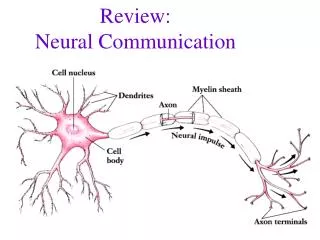
Saltatory Conduction • Myelinated neurons • oligodendroglia & Schwann cells • Transmit long distances • APs relatively slow, regenerates • EPSPs - fast, decremental • Saltatory: combines both types of current • speed without loss of signal ~
Saltatory Conduction • Nodes of Ranvier • action potentials • Myelinated • like electricity through wire • decremental but triggers AP at next node • Safety factor - trigger AP across 5 nodes • .2 - 2 mm apart • larger neurons farther apart ~
Saltatory Conduction Nodes of Ranvier
Graded Summation longer duration *10-100 msec chemical-gated passive spread instantaneous decremental All-or-none short 1-2 msec voltage-gated propagated slow nondecremental PSPs vs APs