Measuring Real Wealth in New Zealand
This paper explores the limitations of Gross Domestic Product (GDP) as a measure of societal well-being in New Zealand and emphasizes the necessity for a more integrated framework of indicators. It discusses the Genuine Progress Indicator (GPI) and other wellbeing metrics that consider aspects such as equity, environmental health, and community vitality. The research highlights existing initiatives and proposes a model for a national index of progress and well-being that supports global comparability. The aim is to foster a comprehensive understanding of true wealth and sustainability for future generations.

Measuring Real Wealth in New Zealand
E N D
Presentation Transcript
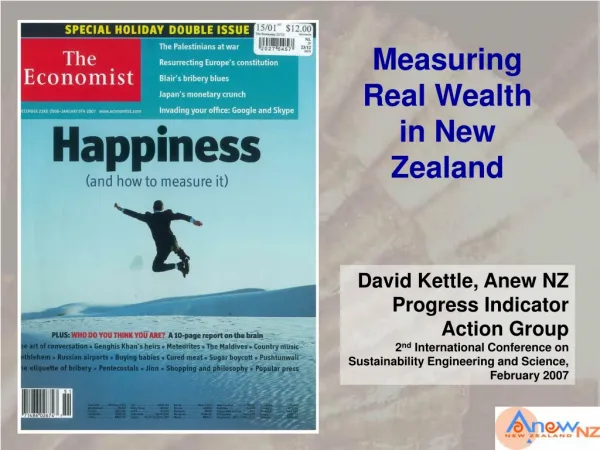
Measuring Real Wealth in New Zealand David Kettle, Anew NZ Progress Indicator Action Group 2nd International Conference on Sustainability Engineering and Science, February 2007
OUTLINE • Introduction • Current Measures of Progress (GDP) • Genuine Progress Indicators (GPI) • Other Wellbeing Indicator Work • Going Forward in New Zealand
INTRODUCTION • Significant Current Indicators Work • Challenge - Integrate and comparability, - Misuse of GDP • Key question • “How can we create an integrated system of indicators …….. global comparability………… combines present well-being with long term sustainability………. while challenging the misuse of GDP as being the basic indicator of societal well-being?”
Why we need measures to complement GDP (Gross Domestic Product) • Every expenditure as addition to well-being(e.g. cyclones, war, etc.) • Ignores functions that don’t involve money(e.g. volunteers, open spaces, trees etc.) • No regard for future (e.g. depletion of natural resources as current income instead of liquidation of an asset) • Ignores distribution of income (e.g. the gap between the haves and have-nots)
Average income & happiness in the US, 1957-2002
Things of personal importance to Kiwi’s Growth & Innovation Advisory Council 2004 0 is not important and 10 is very important 100%
Genuine Progress Indicators(Example: Nova Scotia GPI, Ron Colman)
Canadian Index of Wellbeing (CIW) • Living Standards – gap between rich & poor, food security, affordable housing • Time Allocation – balance between paid work, unpaid work & free time • Healthy Populations – self-rated health, infant mortality, rates of suicide • Ecosystem Health – air & water quality, healthy forests, soils • Educated Populace – literacy, numeracy • Community Vitality – safe communities, diversity, culture, arts • Civic Engagement – meaningful participation
The 6 Capitals of Wellbeing • Produced (Built) Capital – machinery, equipment • Financial Capital – loans, financial savings • Natural Capital – renewable and non-renewable natural resources • Social Capital – values and understanding within and between groups • Human Capital – knowledge skills through life-long learning • Cultural Capital – traditions and behaviours
At a Global Level • United Nations Statistics Division – City Groups on Statistical Methodologies (http://unstats.un.org/unsd/methods/citygroup/index.htm). • The European Social Survey (http://ess.nsd.uib.no). • OECD 2006 Factbook (www.SourceOECD.org/factbook). • June, 2006 Milan OECD ‘post conference’ on a ‘National Index of Wellbeing’ - developing a national index of wellbeing model to be presented at: • OECD Global Project – Measuring the Progress of Societies, Second OECD World Forum on Statistics, Knowledge and Policy, 27-30 June 2007, Instanbul, Turkey
Existing good work in NZ • Quality of life in our • cities; now 12 largest • Excellent MSD social reports • Marilyn Waring’s pioneering • work; in assoc. with Dr. Colman • Local Gov. Act 2002; LTCCP’s
A Pathway for Going Forward in NZ • Support Local and Regional Governments in developing wellbeing indicators • Resource Kit of best practice and “standardisation” • Research and Resourcing • Develop international comparability model • New Zealand Measures of Wellbeing
The AnewNZ Initiative “A National Index of Progress and Wellbeing, Developing a Model for Global Comparability”, November 2007 Six to Eight Countries, including OECD Demonstrate viability of comparable set Agree on wording and data bases
www.anewnz.org.nz • David Kettle – dbkettlelimited@slingshot.co.nz • Dave Breuer • Chris Ferkins • Gary Russell • John Shaw • Ray Skinner • Antony Vallyon