Cryptography
This article delves into the fundamental concepts of cryptography, focusing on symmetric-key encryption models like transposition ciphers and the use of one-time pads. It also covers the RSA public-key algorithm, detailing steps such as choosing large prime numbers, computing keys, and the encryption/decryption process. Learn how public-key algorithms enable secure messaging, the importance of public and private keys, and the role of digital certificates in ensuring secure communication.

Cryptography
E N D
Presentation Transcript
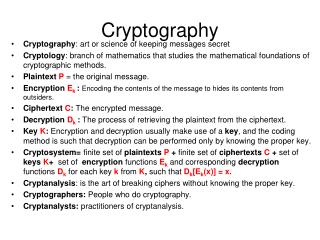
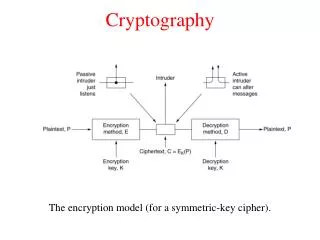
Cryptography • The encryption model (for a symmetric-key cipher).
Transposition Ciphers • A transposition cipher.
One-Time Pads The use of a one-time pad for encryption and the possibility of getting any possible plaintext from the ciphertext by the use of some other pad.
RSA Public-Key Algorithm 1. Choose two large primes, p and q (typically 1024 bits) 2. Compute n = p x q and z = (p-1) x (q-1) 3. Choose a number realtively prime to z and call it d. 4. Find e such that e x d = 1 mod z To encrypt P: C = P^e (mod n) To decrypt C: P = C^d (mod n) (e, n) is the public key and (d, n) is the private key. You freely distribute your public key.
Using Public-Key Algorithms Encrypted message M EBpub B A Bpub Bpriv Apriv Apub Signed message M hash(M) EApriv Certificates Apub E(signing authority)