Understanding the Gerund: A Deep Dive into Grammar and Related Terms
40 likes | 161 Vues
This lesson focuses on the Latin root "Crim," meaning fault, crime, or accusation. Learn how to use the term "incriminate" and understand "recrimination" as a counter accusation. We delve into verbals, particularly the gerund, which ends in -ing and functions as a noun. Explore how to identify a gerund within sentences by finding the simple subject and predicate. With examples like "Speech writing proved challenging," this lesson provides clarity on the gerund's usage and its grammatical significance.


Understanding the Gerund: A Deep Dive into Grammar and Related Terms
E N D
Presentation Transcript
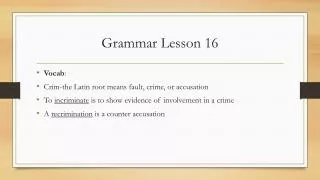
Grammar Lesson 16 • Vocab: • Crim-the Latin root means fault, crime, or accusation • To incriminate is to show evidence of involvement in a crime • A recrimination is a counter accusation
Verbals: the Gerund as a Subject • A verbal is a verb form that does not function as a verb • May function as a noun, an adjective, or an adverb • 3 kinds: the gerund, the infinitive, and the participle
The Gerund • Ends in –ing and functions as a noun • In this lesson, we will see how the gerund can be used as a subject • To determine if a verb ending in –ing is a gerund, we must see how it is used in a sentence • 1. find the simple predicate • 2. find the simple subject
How to Find a Gerund • If the –ing form of the verb is the simple subject, then the subject of the sentence is a gerund • Example: Speech writing proved challenging. • Notice that we diagram the gerund on a “stair-step” line above the base on “stilts”