Download
1 / 17
170 likes | 288 Vues
This lesson focuses on the order of operations, a crucial concept in mathematics that ensures consistent answers when evaluating expressions. Students will learn to apply the properties of operations to add and subtract rational numbers and perform operations on linear expressions with rational coefficients. Through engaging examples and practice problems, participants will become proficient in using the phrase "Please Excuse My Dear Aunt Sally" (PEMDAS) to solve expressions accurately and avoid common pitfalls in calculations.

E N D
Order of Operations • Find Seat • Sharpen Pencil • Pick-up Warm-up and begin • Sit quietly once finished
ObjectiveYou will be able to… 7.NS.1d Apply properties of operations as strategies to add and subtract rational numbers. 7.EE.1 Apply operations to add, subtract, factor, and expand linear expressions with rational coefficients MP.6 Attend to precision MP.8 Look for and express regularity in repeated reasoning
Evaluate 7 + 4 • 3. Is your answer 33 or 19? You can get 2 different answers depending on which operation you did first. We want everyone to get the same answer so we must follow the order of operations.
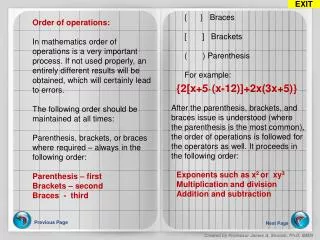
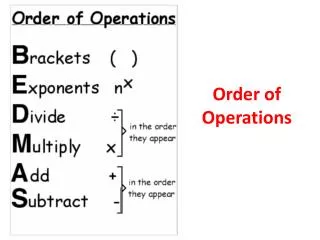
Remember the phrase“Please Excuse My Dear Aunt Sally” or PEMDAS. ORDER OF OPERATIONS 1. Parentheses - ( ) or [ ] 2. Exponents or Powers 3. Multiply and Divide (from left to right) 4. Add and Subtract (from left to right)
Once again, evaluate 7 + 4 3 and use the order of operations. = 7 + 12 (Multiply.) =19(Add.)
Example #114 ÷ 7 • 2 - 3 = 2 • 2 - 3 (Divide l/r.) = 4 - 3 (Multiply.) = 1(Subtract.)
Example #23(3 + 7) 2 ÷ 5 = 3(10) 2 ÷ 5 (parentheses) = 3(100) ÷ 5 (exponents) = 300 ÷ 5 (multiplication) =60 (division)
Example #320 - 3 • 6 + 102 + (6 + 1) • 4 = 20 - 3 • 6 + 102 + (7) • 4 (parentheses) = 20 - 3 • 6 + 100 + (7) • 4 (exponents) = 20 - 18 + 100 + (7) • 4 (Multiply l/r.) = 20 - 18 + 100 + 28 (Multiply l/r.) = 2 + 100 + 28 (Subtract l/r.) = 102 + 28 (Add l/r.) =130 (Add.)
Answer Now Which of the following represents 112 + 18 - 33· 5in simplified form? • -3,236 • 4 • 107 • 16,996
Answer Now Simplify16 - 2(10 - 3) • 2 • -7 • 12 • 98
Answer Now Simplify24 – 6 · 4 ÷ 2 • 72 • 36 • 12 • 0
Evaluating a Variable ExpressionTo evaluate a variable expression: • substitute the given numbers for each variable. • use order of operations to solve.
Example # 4 n + (13 - n) 5 for n = 8 = 8 + (13 - 8) 5 (Substitute.) = 8 + 5 5 (parentheses) = 8 + 1 (Divide l/r.) = 9(Add l/r.)
Example # 5 8y - 3x2+ 2n for x = 5, y = 2, n =3 = 8 2- 3 52 + 2 3 (Substitute.) = 8 2 - 3 25 + 2 3 (exponents) = 16- 3 25 + 2 3 (Multiply l/r.) = 16 -75 + 2 3 (Multiply l/r.) = 16 - 75 + 6 (Multiply l/r.) = -59 + 6 (Subtract l/r.) = -53 (Add l/r.)
Answer Now What is the value of -10 – 4x if x = -13? • -62 • -42 • 42 • 52
Answer Now What is the value of 5k3 if k = -4? • -8000 • -320 • -60 • 320
Answer Now What is the value ofif n = -8, m = 4, and t = 2 ? • 10 • -10 • -6 • 6