Unveiling the Witch-Hunting Craze: Understanding Early Modern Beliefs in Witches
Explore the historical context of the witch-hunting frenzy in 16th and 17th century England. Investigate why women were often accused of witchcraft and delve into the societal factors that fueled these superstitions, including extreme religious views, societal tensions, and economic hardship. Understand the characteristics of witchcraft and examine the notorious methods used by witch hunters like Matthew Hopkins. This lesson encourages critical comparison of historical narratives and promotes engagement through group discussions and creative tasks.

Unveiling the Witch-Hunting Craze: Understanding Early Modern Beliefs in Witches
E N D
Presentation Transcript
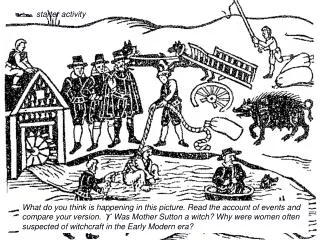
starter activity What do you think is happening in this picture. Read the account of events and compare your version. Was Mother Sutton a witch? Why were women often suspected of witchcraft in the Early Modern era?
Key words: persecuted ‘swimming’ familiar Why did people believe in witches? Plenary Learning objectives TBAT explain at least 5 reasons why the witch-hunting craze started in England in the sixteenth & seventeenth centuries … identify characteristics of witchcraft
Your task • Read Wilkes, p.58-9 & Cumming, p.102-3 and note down 5 reasons why witchcraft increases in this period. • Which ‘factor’ best explains the rise of the witch-hunting craze
Reasons for witch-hunting craze Religion – extreme religious views e.g. Puritanism saw witchcraft as an explanation for illness & the unknown Governments – news laws, e.g. 1542 Witchcraft Law & interest by leaders, e.g. James I wrote ‘Daemonologie’ Attitudes – tensions caused by Reformation & Civil War led to score settling in communities
Reasons for witch-hunting craze Poverty – economic hardship caused tensions leading to people being made scapegoats Education – lack of scientific understanding of natural world, e.g. natural disasters blamed on witchcraft Financial gain – witch finders paid for uncovering witchcraft; authors & printers sold pamphlets & books
Your task Read about the real-life witch finder, Matthew Hopkins in Wilkes p.60 & Dawson p.80. Make a list of ways in which Hopkins detected if people were witches. Why did people confess?
Signs of witchcraft • ‘Familiars’ or imps – e.g. animals present when witchcraft occurred • Devil’s marks – e.g. scars, boils or spots • Failing the swimming test – guilty if floated • Third nipple or teat on victim’s body • Making images of victims, e.g. puppets or pictures • Refusal to attend church • Inability to recite prayers or sections from the Bible • Often elderly or ‘outsiders’ • Uses an alias, e.g. a nickname • Mumbling spells or curses
Watch this trailer for a 1968 British horror movie about Matthew Hopkins. What does it teach us about witch hunters and witchcraft? How useful really is a film like this for finding out about the witch-hunting craze in sixteenth and seventeenth century England?
Group task Work in groups of 5. One of you is a local magistrate. The others are witch finders describing potential cases of witchcraft you have uncovered. Listen to the statements from each witch finder – based on real cases and decide which is the most convincing case of witchcraft. The winning witch finder should be given a fruition for their work.
Homework • Matthew Hopkins is coming to Folkestone. Produce a poster advertising his services. Include the following: • Information on his background • Cases of witchcraft he has successfully uncovered • Methods of detection • Write a radio advert for Witch FM
Key words: persecuted ‘swimming’ familiar Why did people believe in witches? Plenary Learning objectives TBAT explain at least 5 reasons why the witch-hunting craze started in England in the sixteenth & seventeenth centuries … identify characteristics of witchcraft