Understanding Business Cycles: From GDP Trends to Federal Reserve Policies
This comprehensive overview explores the intricacies of business cycles, highlighting key concepts such as Real GDP peaks and troughs, the definitions of expansion and recession, and theories behind economic fluctuations. It also delves into unemployment rates, types of unemployment, and inflation dynamics, including demand-pull and cost-push inflation. The role of the Federal Reserve, including its major functions and monetary policies, is examined to provide insight into how these factors influence economic stability and growth.

Understanding Business Cycles: From GDP Trends to Federal Reserve Policies
E N D
Presentation Transcript
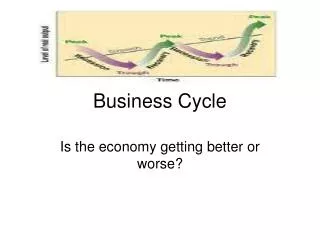
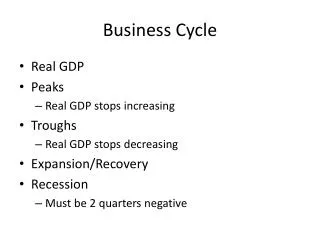
Business Cycle • Real GDP • Peaks • Real GDP stops increasing • Troughs • Real GDP stops decreasing • Expansion/Recovery • Recession • Must be 2 quarters negative
Business Cycle Theories • Innovation • Psychological • Inventory • Monetary • Underconsumption • Exogenous • External Shock
Predicting the Business Cycle • Unemployment • Consumer Goods • Durable Goods • Housing • CPI/PPI • Money Supply
Unemployment • People available for work who made a specific effort to find a job during the past month and who, during the most recent survey worked less than one hour for pay.
Unemployment Rate • Number of unemployed/Labor Force • Under reported • Discouraged workers
Types of Unemployment • Frictional • Structural • Cyclical • Seasonal
Full Employment • 4-5% • Why?
Inflation • Rise in general price level
Deflation • Decrease in general price level
Disinflation • Rate of inflation decreasing
Demand Pull Inflation • Excessive demand for goods and services
Cost Push Inflation • Wage Price Spiral • Wage increases lead to higher prices • Profit-push Inflation • Large corporations keep prices high • Supply Side Shock • Oil
Consumer Price Index (CPI) • Increase of price on the consumer level
Producer Price Index (PPI) • Increase of price at the producer level
Market Basket • Check of recipes month to month
Types of Inflation • Creeping • Galloping • Hyper
Misery Index • Combines inflation rate and unemployment rate. • Not a useful economic measure, more of a social measure
The Federal Reserve Federal Reserve Act of 1913 7 Members of Board of Governors 14 year terms Election every 2 years Chairman of the Board 4 year term 12 District banks Board of Governors in Washington DC National bank, privately owned
Districts • http://upload.wikimedia.org/wikipedia/commons/thumb/3/3e/Federal_Reserve_Districts_Map.svg/800px-Federal_Reserve_Districts_Map.svg.png
The Fed’s Main Jobs • Conduct Monetary Policy • Lender of last resort • Issue Currency • Provide banking services to the US Gov’t • Supervise and regulate our financial institutions
Legal Reserve Requirements • Required reserves • Actual reserves • Excess reserves
Reserves • Primary • Secondary
Federal Open Market Committee • People who conduct open market operations • Board of governors (7) • President of NY Fed District Bank • Presidents of 4 other Fed District Banks (rotate)
The Fed’s Policies • Tight Policy • Loose Policy
The Fed’s Tools • Open Market Operations • Reserve Requirement • Discount Rate