Understanding Chemical Stoichiometry and Atomic Weights: Essentials of Chemical Reactions
210 likes | 336 Vues
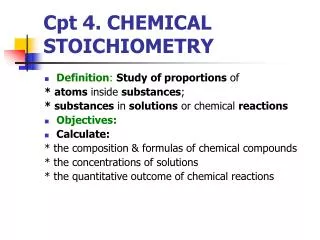
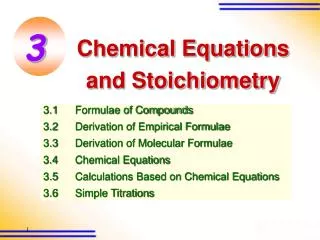
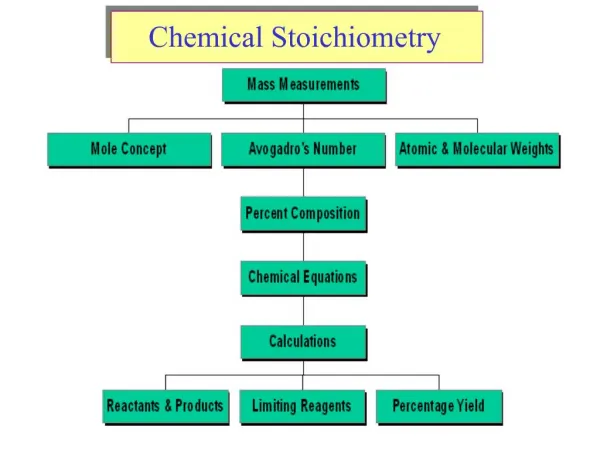
This text explores fundamental concepts in chemical stoichiometry, including average atomic masses, chemical reactions, and the mole concept. It illustrates how to measure substances with precision and provides insight into combustion reactions and the calculation of molar masses. Additionally, it covers empirical formulas and percentage composition from formulas. Key chemical equations are analyzed to enhance understanding of precipitation reactions and their significance in chemistry, making it essential for students and professionals alike.


Understanding Chemical Stoichiometry and Atomic Weights: Essentials of Chemical Reactions
E N D
Presentation Transcript
Atomic Weights • Average Atomic Masses • Relative atomic mass: average masses of isotopes: • Naturally occurring C: 98.892 %12C + 1.108 %13C. • Average mass of C: • (0.98892)(12 amu) + (0.01108)(13.00335) = 12.011 amu. • Atomic weight (AW) is also known as average atomic mass (atomic weight). • Atomic weights are listed on the periodic table. But …1 amu = 1.66054 x 10⁻²⁴ g , still verysmall, how do we Measure Chemicals with our 3 decimal place balances ? !!!
Chemical Equations • Lavoisier: mass is conserved in a chemical reaction. • Chemical equations: descriptions of chemical reactions. • Two parts to an equation: reactants and products: • 2H2+ O22H2O
Some Simple Patterns of Chemical Reactivity Combustion in Air Combustion is the burning of a substance in oxygen from air: C3H8(g) + 5O2(g) 3CO2(g) + 4H2O()
The Mole • Mole: convenient measure of chemical quantities. • 1 mole of something = 6.0221367 1023 of that thing. • Experimentally, 1 mole of 12C has a mass of 12 g. • Molar Mass • Molar mass: mass in grams of 1 mole of substance (units g/mol, g mol-1). • Mass of 1 mole of 12C = 12 g.
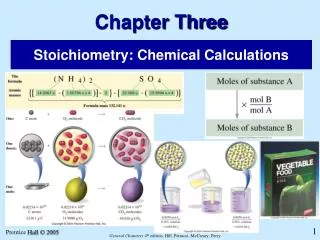
The Mole 1 amu = 1.66054 x 10⁻²⁴ g 1 g = 6.02214 x 10²³ amu
The Mole This photograph shows one mole of solid (NaCl), liquid (H2O), and gas (N2). CyberChem: Mole
Formula Weights • Percentage Composition from Formulas • Percent composition is the atomic weight for each element divided by the formula weight of the compound multiplied by 100:
Percents to Formula % relative mass relative moles simplest atom ratio simplest integer ratio Example 1: (a) Hydrazine contains 87.50% Nitrogen and 12.50% Hydrogen. What is its simplest formula? (b) If its molecular weight is 34.0 g, what is its molecular formula? Example 2: Find the empirical formula for a compound with the following composition: Na = 34.6% P = 23.3% O = 42.1% [Ans: Na4P2O7]
Calculations with Balanced EquationsStoichiometric Coeff’s - Moles - Quantitative C3H8(g) + 5 O2(g) 3 CO2(g) + 4 H2O() MW(g/mol): 44.11 32.00 44.01 18.02 • Look for Balanced Chemical Equation • Focus onto Species concerned • Convert to Moles of Species • Convert to Equivalent Moles of Species in Question • Convert to Desired Units • Use the Factor Label Method
At room temperature and pressure, sodium is dissolved in water to give sodium hydroxide and hydrogen.
Precipitation Reactions • When two solutions are mixed and a solid is formed, the solid is called a precipitate.