Understanding Functions and Transformations: Operations, Reflections, and Translations
This lesson explores the concept of functions, identifying whether a relation is a function, and the operations associated with it. Students will engage in warm-up activities based on real-world data and practice translating points on a coordinate plane. The unit covers transformations including translations, reflections, stretches, and compressions, with practical examples and exercises. By the end, learners should be able to apply these transformations to functions and understand their geometric implications.

Understanding Functions and Transformations: Operations, Reflections, and Translations
E N D
Presentation Transcript
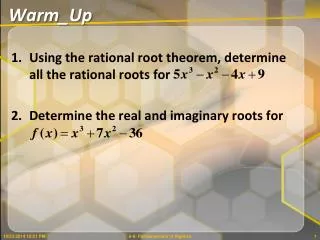
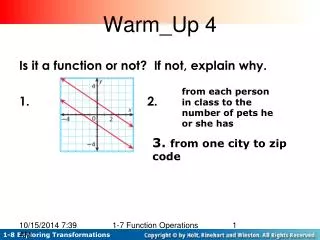
1-7 Function Operations Is it a function or not? If not, explain why. 1.2. Warm_Up 4 from each person in class to the number of pets he or she has 3.from one city to zip code
1-7 Function Operations Pg 47: 5-29 odd, 39-42 all, 41 a-b Page 47
Exploring Transformations Section 1-8
A transformation is a change in the position, size, or shape of a figure. A translation, or slide, is a transformation that moves each point in a figure the same distance in the same direction. Definitions
Example 1A: Translating Points Perform the given translation on the point (–3, 4). Give the coordinates of the translated point. 5 units right 5 units right (-3, 4) (2, 4) Translating (–3, 4) 5 units right results in the point (2, 4).
2 units 3 units (–5, 1) Example 1B: Translating Points Perform the given translation on the point (–3, 4). Give the coordinates of the translated point. 2 units left and 3 units down (–3, 4) Translating (–3, 4) 2 units left and 3 units down results in the point (–5, 1).
Notice that when you translate left or right, the x-coordinate changes, and when you translate up or down, the y-coordinate changes.
A reflection is a transformation that flips a figure across a line called the line of reflection. Each reflected point is the same distance from the line of reflection, but on the opposite side of the line.
Example 2A: Translating and Reflecting Functions Use a table to perform each transformation of y=f(x). Use the same coordinate plane as the original function. translation 2 units up
Example 2A Continued translation 2 units up Identify important points from the graph and make a table. Add 2 to each y-coordinate. The entire graph shifts 2 units up.
Example 2B: Translating and Reflecting Functions reflection across x-axis Identify important points from the graph and make a table. Multiply each y-coordinate by –1. The entire graph flips across the x-axis.
Imagine grasping two points on the graph of a function that lie on opposite sides of the y-axis. If you pull the points away from the y-axis, you would create a horizontal stretch of the graph. If you push the points towards the y-axis, you would create a horizontal compression.
Stretches and compressions are not congruent to the original graph. Stretches and Compressions
Example 3: Stretching and Compressing Functions Use a table to perform a horizontal stretch of the function y = f(x)by a scale factor of 3. Graph the function and the transformation on the same coordinate plane. Identify important points from the graph and make a table. Multiply each x-coordinate by 3.
Check It Out! Example 4 Recording studio fees are usually based on an hourly rate, but the rate can be modified due to various options. The graph shows a basic hourly studio rate.
If the price is discounted by of the hourly rate, the value of each y-coordinate would be multiplied by . Check It Out! Example 4 Continued What if…? Suppose that a discounted rate is of the original rate. Sketch a graph to represent the situation and identify the transformation of the original graph that it represents.
Pg 63: 15, 17, 19, 25-35 odd Assignment