Understanding the Combined Gas Law: Pressure, Volume, and Temperature Relationships
180 likes | 359 Vues
The Combined Gas Law illustrates the interplay between pressure, volume, and temperature of a gas. It states that at constant amounts of gas, pressure and volume are inversely proportional, while temperature is directly proportional. This relationship is expressed in the formula PV/T = K, where K is a constant. Through practical examples, such as calculating gas volume at standard temperature and pressure (STP), we explore how changes in one variable affect the others. Understanding these concepts is crucial in fields like chemistry and physics.


Understanding the Combined Gas Law: Pressure, Volume, and Temperature Relationships
E N D
Presentation Transcript
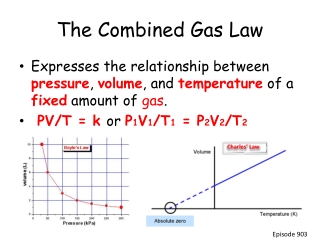
Combined Gas Law • The pressure and volume of a gas are inversely proportional to each other, but directly proportional to the temperature of that gas. • Table T of Reference Tables • Temperature must be in K (Kelvin).
Temperature • Table T of Reference Tables Water Boils Water Freezes Absolute Zero
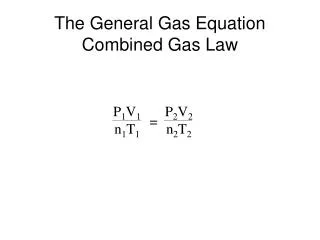
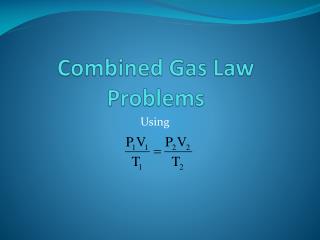
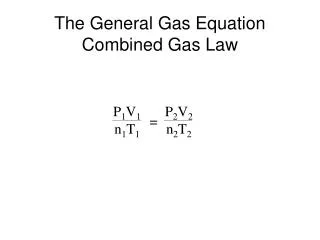
Combined Gas Law Temperature = Volume x Pressure / ConstantVolume = Constant x Temperature / PressurePressure = Constant x Temperature / VolumePressure x Volume/Temperature = Constant • Substituting in variables, the formula is:PV/T=K • K is a constant = n (amount) R (gas constant)
Combined Gas Law Because the formula is equal to a constant, it is possible to solve for a change in volume, temperature, or pressure using a proportion:
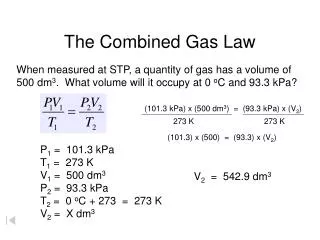
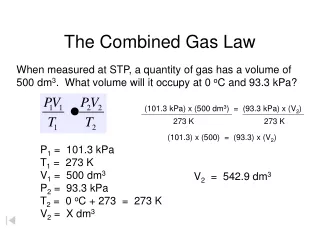
Using Gas Law Equation: At a temperature of 27°C and a pressure of 50.65 kPa, 60.0 mL of a gas is collected. What would the volume of the gas be at STP? • STP is 273 K and a pressure of 101.3 kPa • Set up the equation:
Using the Gas Law Equation: • Temp. must be in Kelvin, so convert: 27°C + 273 = 300 K • T1 is 300K • V1 is 60.0 mL • P1 is 50.65 kPa • T2 is standard temperature 273 K • P2 is standard pressure 101.3 kPa • V2 is ?
Solution: (50.65 kPa)(60.0 mL) (101.3 kPa)(V2) = 300 K 273 K
Solution: 3039 kPamL (101.3 kPa)(V2) = 300 K 273 K
Solution: 10.13 kPamL = (101.3 kPa)(V2) K 273 K
Solution: (273 K) 10.13 kPamL = 101.3 kPa (V2)(273K) K 273 K
Solution: 2765.49 kPamL = 101.3 kPa(V2) 2765.49 kPamL = 101.3 kPa(V2) 101.3 kPa 101.3 kPa V2 = 27.3 mL
Learning Check • A gas has a volume of 25.0L at a temperature of 27°C and a pressure of 1.00 atm. The gas is allowed to expand to a new volume of 50.0 L. The pressure is now 0.40 atm. What is the final temperature? • T2 = 240 K
Boyle’s Law • Temperature is Constant
Boyle’s Law • In the mid 1600's, Robert Boyle studied the relationship between the pressure pand the volume V of a confined gas held at a constant temperature. Boyle observed that the product of the pressure and volume are observed to be nearly constant. Boyle's Law and Syringe Video
Boyle’s Law – Balloon Demo • Inflating a Sealed Balloon Video
Learning Check A balloon contains 30.0 L of helium gas at 103 kPa. What will the volume be if the pressure is changed to 25 kPa at constant temperature? • P1V1 = P2V2 • (103 kPa)(30.0 L) = 25 kPa (V2) • 3090 kPa L = 25 kPa (V2) • 3090 kPa L = V2 25 kPa V2 = 123.6 L
Boyle’s Law • Pressure increases then Volume decreases • Pressure decreases then Volume increases