Unreliable Narrators and Literary Ambiguity in Literature
Explore the fascinating world of ambiguity through unreliable narrators in literature, analyzing characters, settings, and symbolism. Delve into hidden meanings and contradictory elements that shape the narrative.

Unreliable Narrators and Literary Ambiguity in Literature
E N D
Presentation Transcript
Ambiguity Two meanings in Literature and Art
Definition of Ambiguity • The presence of two or more possible meanings in any passage. • Deliberately creates confusion by using a word or phrase with two or more meanings in one of the premises of an argument. • Doubtfulness or uncertainty as regards interpretation. • Something of doubtful meaning.
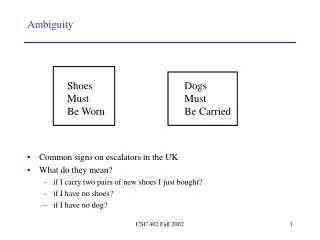
Examples of Ambiguity • "Prostitutes Appeal to Pope"(newspaper headline) • “Union Demands Increased Unemployment"(newspaper headline) • 'The chicken is ready to eat‘ • 'Tibetan history teacher'
Chapter 1: the governess • You should be annotating for: • Characterisation • Setting • A Key Incidents • Literary Technique • Symbolism • Atmosphere • Dialogue • Sentence structure • Punctuation • Imagery etc.
I remember the whole beginning as a succession of flights and drops, a little see-saw of the right throbs and the wrong.
Trusting the narrative voice “I had at all events a couple of very bad days – found all my doubts bristle again”. • An unreliable narrator is a first-person narrator that for some reason has a compromised point-of-view. • In all stories with a first-person narrator, the narrator serves as a filter for the events. • What the narrator does not know or observe cannot be explained to the reader. • Usually, however, the reader trusts that the narrator is knowledgeable and truthful enough to give them an accurate representation of the story. • In the case of an unreliable narrator (sometimes called a fallible narrator), the reader has reason not to trust what the narrator is saying.
Why can’t we trust the narrator? An unreliable-narrator has limited capacities because of: 1) Tunnel vision -narrator sees only one type of thing. 2) Confused emotions -narrator’s involvement keeps him or her from being an accurate reporter. 3) Naiveté-narrator is incapable of understanding what he or she reports.
When studying a text, look for: Moments of Realisation When a character realises something – ask yourself “how might this change things?” Words of wisdom When your protagonist is given serious advice – ask yourself “what’s the life lesson here?” repetition If a word, phrase, object or place is mentioned again and again– ask yourself “why?” Contrasts & Contradictions A character or an event contradicts what has gone before – ask yourself “why?” Memory moment The action stops to share a memory – ask yourself “why might this memory matter?” Tough questions Characters often ask themselves questions – ask yourself “what does this link to?”
Notes on: • The presentation of the governess – how much about herself does she reveal? • The setting at Bly – how does James keep to the gothic tradition? How does he break it? • Flora – how does the governess shape the readers’ first impressions? • Mrs Grose – again, how does the governess shape the readers’ first impressions? What hints are there of class snobbery? • Miles – descriptions of him in absentia.