Understanding the U.S. Court System: Key Concepts and Judicial Processes
This course offers an in-depth exploration of the United States Court System and its unique characteristics within the framework of the Constitution. Students will learn to interpret the Constitution, grasp the roles of formal institutions, and analyze how the court system addresses policy dilemmas. Topics include the structure of the Supreme Court, the Federal District Courts, the impact of the presidency on judicial appointments, the process through which cases reach the Supreme Court, and the limits on the Court’s power through historical cases. Office hours for further discussion are also provided.

Understanding the U.S. Court System: Key Concepts and Judicial Processes
E N D
Presentation Transcript
Courts 2/28/2012
Clearly Stated Learning Objectives • Upon completion of this course, students will be able to: • understand and interpret the United States Constitution and apply it to present policy dilemmas • Identify and explain the role of formal institutions and their effect on policy. • students will have a better understanding of why our national government works and why the American system of government is unique.
Office Hours and Readings • Readings- Chapter 11 on the Courts • Office Hours • Today- 11-2 • Wednesday 10-2
Article III The supreme court
The Courts in the Constitution • Article III Section I • One supreme court • Ability to Create others • Tenure of office • Article III Section 3- treason
Article III Section 2 • ambassadors and other ministers, counsels, and admiralty • controversies between two or more states • between citizens vs foreign citizens or states.
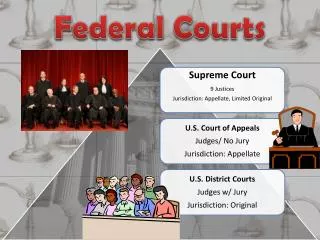
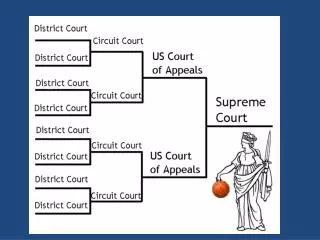
Federal District Courts • The Main Trial Courts of the System • Federal Crimes are Tried here • The Federal Court Downtown
Court of Appeals • can only hear appeals • lacks original jurisdiction • Our court is in New Orleans
The Supreme Court • Chief Justice • 8 Associate Justices • Court packing
Jurisdiction • Original • Appellate
No Age or Education requirements How you get on the court
Role of the President • A very great power • The president plays politics here.
How Presidents Decide • try to appoint people like themselves (90% of all Justices come from the President's party) • Political Factors • the courts need to work with the president to ensure its actions are followed. • You hope you avoid “back-stabbers”
The Senate • Increasingly partisan since the 1980’s • Senatorial Courtesy for Lower-Level Judges • Temporal Forces
Other Players • Interest Groups • The Media • The Public
The politics of it all How cases reach the supreme court
Justice is not Blind • Cases Reach The court because of policy • They can Hear anything they want (original jurisdiction)
Most Cases Come through The System • Writ of Certiorari • Appeals • The Solicitor General
Does My Case Have A Chance? • No (stare decisis) • What is Likely to Be Heard • What they are Hearing now
The Real Power of the Courts Judicial Review
Marbury vs. Madison • Midnight Judges in 1800 • A New System of Checks and Balances • Overturned by impeachment and amendment
Today’s Court Left Right Scalia (Reagan) Thomas (Bush) Roberts (GW Bush) Alito (GW Bush • Bader-Ginsburg (Clinton) • Breyer (Clinton) • Sotomayor (Obama) • Kagan (Obama)
Applying the Bill of Rights • Barron v. Baltimore 1883 • Too Bad, the Bill of Rights only applies to actions of the Federal Government
Selective Incorporation • Application of the 14th Amendment • Piecemeal application of the Bill of Rights • Gitlow vs. New York changes this (1925)
Limits on the Court’s Power • Amendment • Impeachment • Judges reverse themselves • Wait them Out