Disulfide Connectivity Prediction Using Machine Learning
70 likes | 120 Vues
This thesis explores the accurate prediction of disulfide connectivity patterns in bioinformatics through machine learning approaches, comparing various methods and presenting innovative solutions.


Disulfide Connectivity Prediction Using Machine Learning
E N D
Presentation Transcript
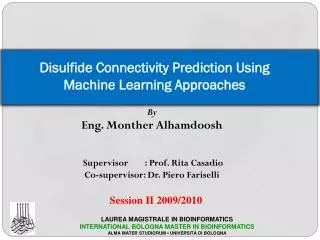
Disulfide Connectivity Prediction Using Machine Learning Approaches By Eng. Monther Alhamdoosh Supervisor : Prof. Rita Casadio Co-supervisor: Dr. PieroFariselli Session II 2009/2010 LAUREA MAGISTRALE IN BIOINFORMATICS INTERNATIONAL BOLOGNA MASTER IN BIOINFORMATICS ALMA MATER STUDIORUM ▪ UNIVERSITÀ DI BOLOGNA
In Literature • Accuracy indices • The percentage of connectivity patterns that are correctly predicted. • The percentage of disulfide bridges that are correctly predicted. δ(x, y) = 1 when the predicted pattern y matches the correct pattern x. • Introduction • The Amino Acid Cysteine • Importance of SS Bonds • Machine Learning • Statement of the Problem • Aim of Research • In Literature • Our Proposed Solutions • Results • Comparisons with previous methods • Conclusions M.Sc. Thesis in Bioinformatics Eng. Monther Alhamdoosh
Our Proposed Solutions • Introduction • The Amino Acid Cysteine • Importance of SS Bonds • Machine Learning • Statement of the Problem • Aim of Research • In Literature • Our Proposed Solutions • Results • Comparisons with previous methods • Conclusions 1 2 Machine Learning 3 4 Pattern Scoring Schemes Basic System Design M.Sc. Thesis in Bioinformatics Eng. Monther Alhamdoosh
Our Proposed Solutions • Step 3: Estimate the disulfide propensity • Neural Networks-based Models • Single-Layer Feed-forward Network (SLFN). • Extreme Learning Machines (ELMs). • Pseudo-inverse matrix to get output weights. • Additive (Sigmoid) Hidden Neurons • RBF (Guassian) Hidden Neurons. • Back-propagation (BP). • Gradient Descent to get all weights. • Support Vector Machines (SVM) • Support Vector Regression (SVR). • Radial Basis Function (RBF) Kernels. • Grid Search is used to find the best values for g and c. • Introduction • The Amino Acid Cysteine • Importance of SS Bonds • Machine Learning • Statement of the Problem • Aim of Research • In Literature • Our Proposed Solutions • Results • Comparisons with previous methods • Conclusions M.Sc. Thesis in Bioinformatics Eng. Monther Alhamdoosh
SLFN • ELM (Additive vs. RBF hidden neurons) • Training Time curves • Introduction • The Amino Acid Cysteine • Importance of SS Bonds • Machine Learning • Statement of the Problem • Aim of Research • In Literature • Our Proposed Solutions • Results • Comparisons with previous methods • Conclusions Number of Neurons Number of Neurons Additive Hidden Neurons RBF Hidden Neurons M.Sc. Thesis in Bioinformatics Eng. Monther Alhamdoosh
ELM outperforms BP • The accuracy values of ELM and BP • Performance Enhancement • Introduction • The Amino Acid Cysteine • Importance of SS Bonds • Machine Learning • Statement of the Problem • Aim of Research • In Literature • Our Proposed Solutions • Results • Comparisons with previous methods • Conclusions M.Sc. Thesis in Bioinformatics Eng. Monther Alhamdoosh
SVR vs. NN • Comparison of SVR and NN-based methods • Both tested on PDB0909 with Set Aof descriptors. • Introduction • The Amino Acid Cysteine • Importance of SS Bonds • Machine Learning • Statement of the Problem • Aim of Research • In Literature • Our Proposed Solutions • Results • Comparisons with previous methods • Conclusions M.Sc. Thesis in Bioinformatics Eng. Monther Alhamdoosh