Hit the Slopes
This educational module, led by Brett Solberg and Sarah Schneider, guides students through the process of deriving a formula to accurately determine the slope of a line. Students will categorize various hills based on a rating system, exploring how steepness is assessed and compared. Key activities include identifying the steepest lines, measuring steepness, and applying the derived formula to real-life examples. By the end of this lesson, learners will understand the fundamental concepts of slope, rise, and run, enhancing their analytical skills in geometry.


Hit the Slopes
E N D
Presentation Transcript
Hit the Slopes Brett Solberg Sarah Schneider Ralph Davis
Objective Students will be able to derive an accurate formula for finding the slope of a line.
Rating Easy Moderate Steep Vertical
Sort and Categorize • Categorize the 6 hills according to our rating system. • How do you determine which hill goes in which category? • How do you determine steepness?
Steepness • Which of these lines is steepest? • What do they have in common? • What are their differences? • Can you measure the steepness of each line?
Steepness • Which of these lines is steepest? • What do they have in common? • What are their differences? • Can you measure the steepness of each line?
Formula • How did you determine steepness? • What problems did you find?
Test • Test out your formula on these lines.
Formula • Did your formula hold? • What problems did you find?
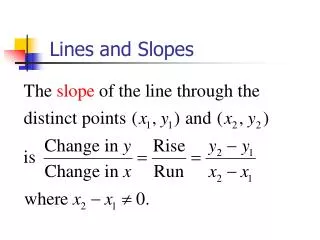
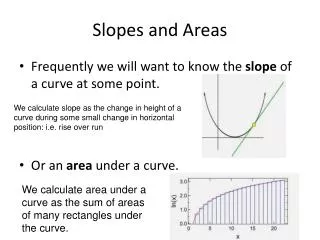
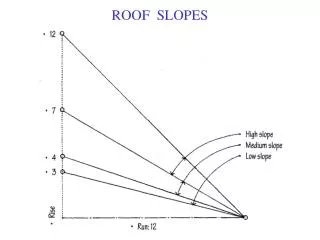
Slope • The slope is defined as the ratio of the "rise" divided by the "run" between two points on a line, or in other words, the ratio of the altitude change to the horizontal distance between any two points on the line.